
Flooring Guide · Hardwood Species
White Oak vs Red Oak Floors for Alpharetta Homes
Last updated: July 8, 2026
The short answer: white oak for kitchens, open main levels, and lighter modern stains; red oak for matching the floors your house already has, or for a warmer, more traditional room. The hardness gap is real but small — white oak measures 1360 on the Janka scale, red oak 1290 — so durability alone rarely settles the question.
What settles it is light, stain color, moisture exposure, and whatever is already nailed down in the next room. This guide walks the same decision path we use during in-home consultations in Alpharetta and Milton, numbers included.
Which oak is better for an Alpharetta home?
White oak is the default recommendation for most Alpharetta projects, and red oak is the deliberate exception. White oak’s tighter grain absorbs less moisture, its neutral base suits the wide-plank, matte, light-stain look North Fulton buyers currently ask for, and its slightly higher hardness gives a busy household a small extra margin. Red oak takes the win in two situations: when new boards must blend with red oak already in the house, and when the goal is a warm, classic room where its pronounced grain reads as character rather than noise. Price rarely breaks the tie — species is a modest slice of an installed cost that runs $6 to $15 per square foot in the Atlanta market, with labor, tear-out, and prep driving the rest. Our flooring installation cost guide itemizes those line items so you can see exactly where a bid comes from.
White oak and red oak at a glance
Six factors cover almost every consultation conversation about these two species. Here is how they compare before any stain or finish enters the picture.
| Factor | White oak | Red oak |
|---|---|---|
| Janka hardness | 1360 — a small edge in busy rooms | 1290 — proven across generations of homes |
| Grain | Tighter, closed, visually calm | Open, pronounced, with visible swirl |
| Natural color | Neutral brown to gray-brown | Warm golden with pink undertones |
| Moisture response | Less porous — suits kitchens and entries | More porous — happiest in drier rooms |
| Under stain | Light and neutral colors read true | Warmth shows through most colors |
| Best match for | Modern palettes, open plans | Traditional trim, existing red oak floors |
Read the table as a tiebreaker rather than a verdict. The finish system, the installation, and the room’s conditions decide how either species actually performs over the next twenty years.
The look each wood brings to a room
Red oak warms a room. Its undertones lean golden to pink, especially under honey and medium-brown stains, which is why it pairs so naturally with classic trim profiles, warm paint colors, and furniture with some age to it.
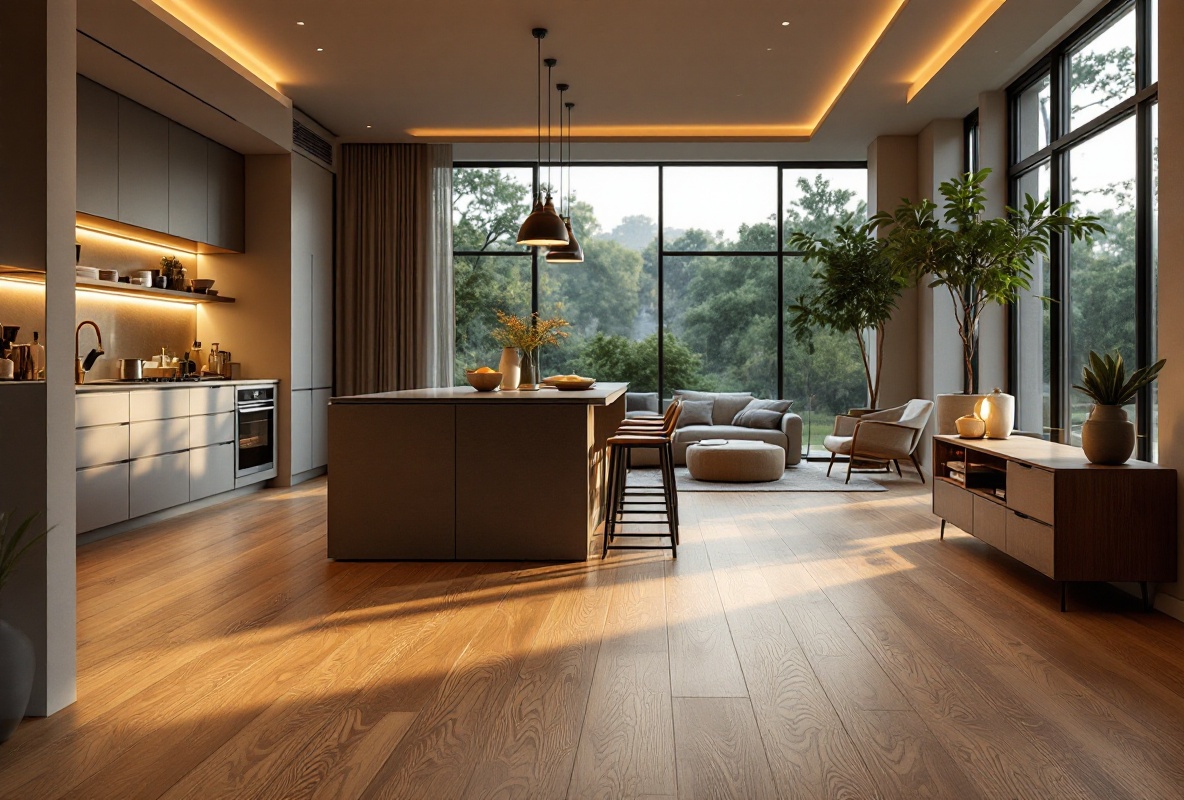
White oak reads quieter. The grain is subtler, the base color sits between neutral brown and gray-brown, and pale stains, natural oils, and matte sheens all look cleaner on it. That calm is why it dominates open-concept main levels, where one floor has to work with white cabinets, brushed hardware, and a lot of daylight.
Daylight is the wildcard. The same board shifts noticeably between morning sun, late-afternoon glow, and warm evening bulbs, which is why we put stain samples on your actual boards, in your rooms, before sanding day — a two-inch showroom swatch cannot tell you what a thousand square feet will do.
Durability, moisture, and everyday wear
On paper, white oak wins the hardness contest 1360 to 1290. In practice, seventy Janka points is a modest edge — the finish on top of the wood does more to determine how dents and scratches show than the species underneath it.
The moisture story separates them further. White oak’s tighter, closed grain takes on less water, which matters for spills near the dishwasher, regular damp mopping, and the humid Georgia summers that push moisture toward every hardwood floor. For kitchens and entryways, that lower porosity is a stronger reason to choose it than the hardness number.
Red oak has floored North Atlanta houses for generations and keeps doing so. With a well-applied finish it stands up to two kids and a dog as reliably as any hardwood — the species asks only that standing water get wiped up rather than left to sit.
Cost, sanding, and refinishing over time
Installed hardwood runs $6 to $15 per square foot in the Atlanta market, and the spread between these two species is usually smaller than the spread caused by grade, plank width, tear-out, and subfloor condition. A bargain on boards disappears quickly if the subfloor needs leveling at roughly $2 to $3 per square foot.
Both species sand and refinish well, which is oak’s long-term advantage over nearly every other floor: at $3 to $8 per square foot, refinishing renews the surface for a fraction of replacement. The species choice resurfaces at refinish time in the stain — white oak keeps light and neutral colors honest, while red oak brings its warmth through whatever color goes on top. Our refinishing cost guide shows where each kind of job lands in that range.
Matching is the other cost question. If part of the house keeps its existing red oak, staying with red oak in the new rooms makes blending realistic — and sanding and finishing everything in one pass is how a main level ends up reading as one continuous floor instead of a patchwork.
Which oak fits each part of the house
Species choice is a room-by-room call more often than a whole-house one. The pattern we see across Alpharetta projects:
- Kitchens and open main levels: white oak, for its lower porosity and a tone that stays balanced under strong daylight.
- Traditional living rooms and bedrooms: red oak, where warmth and visible grain are assets rather than distractions.
- Stairs: match the main floor. Stair work runs $100 to $250 per step, and a species change at the bottom tread is the kind of detail eyes find immediately.
- Basements: settle the moisture plan first. Below grade, an engineered board with an oak veneer is often the honest recommendation, whichever species you prefer on top.
Working through that fit — species, format, and finish against slab, subfloor, and light — is the core of a flooring installation consultation.
Frequently asked questions
Which oak is better for an open-concept kitchen?
White oak, in most cases. Its lower porosity and tighter grain shrug off the splashes and damp mopping a kitchen floor lives with, and its neutral color keeps one continuous tone across a kitchen that opens into the living room. Red oak can serve in a kitchen too — pair it with a durable finish and wipe up standing water promptly.
Can stain make red oak look like white oak?
Not exactly, and anyone promising a perfect conversion is overpromising. Red oak’s pink undertones pull through most stain colors, while white oak starts from a more neutral base, so the same stain reads warmer on red oak. Testing samples on your actual boards is the only reliable way to see the real result before sanding day.
Should new floors match the red oak already in my house?
If you are extending floors room by room, staying with red oak is usually the cleaner outcome — grain and tone blend far better within one species. If the whole level is being redone at once, the slate is blank and either species works.
Does white oak cost more than red oak?
Usually a little, though grade, plank width, and supply move the gap around. Both land inside Atlanta’s $6–15 per square foot installed range, and the difference between species is typically smaller than the swing caused by tear-out, subfloor prep, and stairs.
How we help Alpharetta homeowners decide
We bring the species decision to your house instead of asking you to make it in a showroom. Samples of both oaks go down on your floor, next to your trim and cabinet colors, under your light. We check the subfloor while we are there, then put everything into an itemized, line-item proposal — boards, labor, tear-out, prep — so nothing about the number is mysterious.
One crew handles the work under one contract, whether the project is a single room or floors, stairs, and paint ahead of a move-in. If a comparable written quote comes in lower than ours, we beat it by 5 percent.
See both oaks on your own floor
White oak when you want calm, current, and moisture-tolerant; red oak when you want warmth or a seamless match. A free in-home consultation settles it with samples on your boards, not swatches under showroom lights — and we reply within one business day.
Questions before booking? Call 470-352-1156 or write to [email protected].