
The Flooring Buyer’s Guide
Room-by-room material picks, white oak vs. red oak, refinish-or-replace, and the seven questions to ask before signing any flooring bid — sent straight to your inbox.
One email with the guide. No spam, unsubscribe anytime.
Hardwood Sanding · Refinishing · Restoration
Hardwood floor sanding and refinishing in Alpharetta — minus the dust cloud.
Last updated: July 8, 2026
Bringing a worn hardwood floor back costs $3 to $8 per square foot in Alpharetta, against $6 to $15 to replace it. The typical job takes 3 to 5 days, and with a water-based finish you are walking the boards in socks that same evening.
The money question
What does it cost to sand and refinish hardwood floors in Alpharetta?
Expect $3 to $8 per square foot in 2026. A clean sand and re-coat on healthy boards sits near $3–5; changing the stain color moves the work to roughly $4–6; and restoration jobs with board replacements, pet stains, or water marks climb to $6–8 and sometimes past it. Dust-contained sanding generally prices at $5–8 against $3–5 for open sanding, and once homeowners hear where sanding dust ends up without containment, most decide the difference is cheap. Run the math on a 1,000-square-foot main level and the project usually lands somewhere between $3,000 and $8,000, with stain changes and repairs explaining most of the spread. Because these ranges are published, you can hold our proposal — or anyone else’s — up against them. The refinishing cost guide breaks every scenario down line by line.
Why homeowners call us
The three worries behind almost every refinishing call
“Dust gets everywhere”
Homeowners on flooring forums describe finding sanding dust in closets and vents years afterward. Our sanders run tethered to sealed vacuum containment that grabs dust at the drum, before it ever floats — the full mechanism is explained below.
“What if the color comes out wrong”
A stain you regret is a 15-year regret. So the decision never happens at a counter: sample patches go onto your own boards, in your own light, and sanding day waits until you have signed off on what you actually saw.
“There’s wood under this carpet”
Plenty of 1980s and 1990s Alpharetta homes hide solid oak beneath the upstairs carpet. Pulling carpet and refinishing what is underneath often costs half of what covering it with new flooring would — original hardwood, brought back rather than buried.
The process
From tired boards to final coat, in five documented steps
Walk the floor
A free consultation where we assess board condition, look beneath any carpet, and hear what look you are after.
Test the color
Stain samples get applied to your boards so the choice is made from real wood under your windows, not a chart.
Price it line by line
The proposal itemizes sanding, stain, finish coats, and any repairs — contingencies included — so nothing appears later.
Sand and finish
Dust-contained equipment, sealed rooms, masked vents, and a schedule you received in writing before day one.
Inspect together
A room-by-room review with you, corrections handled, and care instructions matched to your finish.
Service depth
Dust-contained sanding: where the dust goes instead of into your cabinets
The single loudest complaint about refinishing — in online communities and in the stories clients tell us at consultations — is dust that turned up “seriously everywhere,” from kitchen drawers to HVAC returns, long after the crew left. That fear is rational. An open drum sander throws fine wood dust into the air faster than any shop vac can chase it.
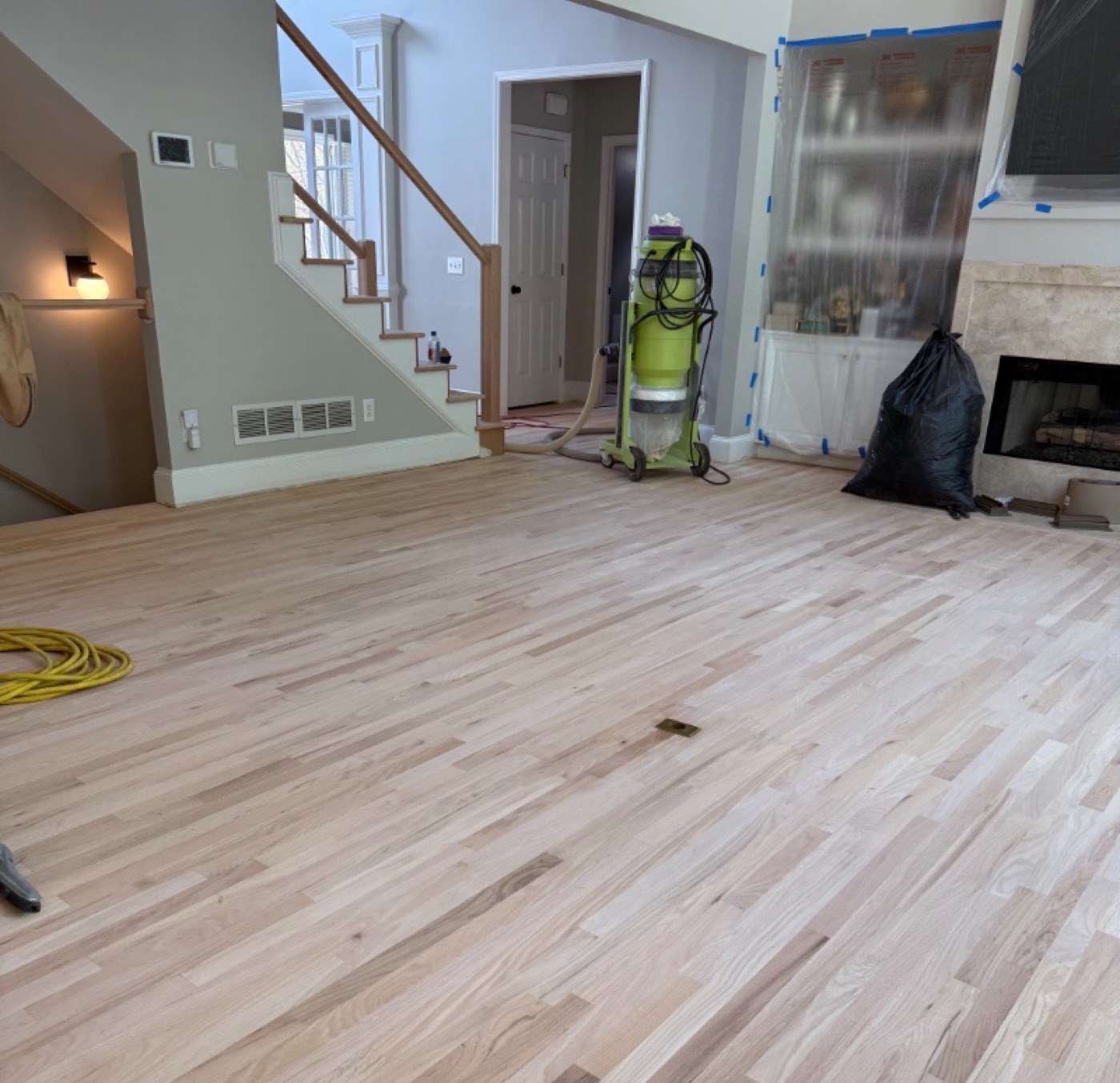
Containment changes the physics. Our machines connect through sealed hoses to high-suction vacuum units that capture dust at the drum, at the moment of sanding, before it becomes airborne. Doorways get sealed, supply and return vents get masked, and edge work runs on extractor-equipped edgers rather than loose orbital sanders. What reaches the air is a small fraction of what traditional sanding releases.
Honesty requires one caveat: no system on the market captures every particle. Corners, stair noses, and hand-scraped repairs still produce some fine dust, and we tell you that before work starts rather than let a wiped windowsill surprise you. The difference is between a light dusting in the work area and a film through the whole house — which is why most of our refinishing clients keep living at home while we work.
Water-based or oil-based finish: what each one costs you in days
Both produce a durable floor. The real difference is what your household’s week looks like, so we put the trade-offs on the table before you commit to either.
Water-based polyurethane is the low-disruption route: minimal odor, walkable in socks the same evening, furniture back in 2 to 3 days, and a clear coat that keeps light woods like white oak looking the way you approved them. Oil-based polyurethane cures into a warm amber that deepens over the years — a tone many owners of older homes specifically want — but it asks more of you: stronger fumes during application and cure, longer waits between coats, and enough lingering odor that families commonly book 2 to 5 nights away.
| Milestone | Water-based finish | Oil-based finish |
|---|---|---|
| Walk in socks | Same evening | Next day or later |
| Furniture returns | 2–3 days | 4–7 days |
| Odor during cure | Low | Strong; many families stay elsewhere 2–5 nights |
| Color over time | Stays clear | Ambers and deepens |
Neither choice is wrong. If you are refinishing before a moving truck arrives or living at home through the job, water-based usually wins the calendar. If you want that traditional amber glow and can plan around the cure, oil earns its wait. We walk you through both against your dates and let the decision be yours.
Stain matching, with the honesty most quotes leave out
The stain-match horror story is always the same: a contractor promises the new floor will blend into the old one, and weeks later the transition “sticks out like a sore thumb.” The promise was the problem. Two decades of sunlight, foot traffic, and aging finish change how wood reads color, and no stain chart accounts for your specific floor.
Our answer is to stop guessing. Before any sanding happens, stain samples are applied directly to your boards — the actual wood, under the actual light from your windows — and you judge the result in the morning and again in the evening. What you approve is what gets rolled across the floor, because it was tested on the floor.
When testing shows a blend simply will not get close enough, we will say so before sanding day and recommend refinishing the whole level so it reads as one floor.
The floors you forgot were under the carpet
Restoration is the version of this service we enjoy most. A surprising share of North Fulton homes built in the 80s and 90s carpeted directly over site-finished oak, and that wood is usually in better shape than anyone expects — protected from sun and wear for thirty years. A consultation includes pulling back a corner of carpet to check. If the boards are sound, sanding and refinishing them at $3–8 per square foot beats installing new hardwood at $6–15, and you keep wood with age and grain character that new planks cannot fake.
Straight answers
Refinishing questions we hear every week
Do we have to move out while our hardwood floors are refinished?
Most families stay. Dust-contained sanding captures the vast majority of dust at the machine instead of letting it drift into vents and cabinets, and a water-based finish is low-odor enough that bedrooms on another level stay livable. The main exception is an oil-based finish, whose cure smell sends many households to a hotel for 2 to 5 nights — a trade-off we lay out before you choose your finish, not after.
How soon can we walk on refinished floors and move furniture back?
With a water-based finish, you can usually walk the floors in socks the same evening and bring furniture back in 2 to 3 days; rugs wait a couple of weeks while the finish fully hardens. Oil-based finishes need noticeably longer at each stage. Whichever finish you pick, the schedule goes to you in writing as a day count, so a listing date or moving truck is planned around real dates rather than guesses.
Can a new stain color match our existing hardwood exactly?
Sometimes within a shade, rarely to perfection — sun, age, and old finish chemistry change how wood takes stain, and a promise of a flawless match to 20-year-old boards should make you skeptical of whoever makes it. That is why our color decisions happen on your actual floor: we test stain samples on your boards, in your light, before sanding day, so you approve the real result instead of a 2-inch swatch.
Is refinishing hardwood floors worth it before selling a home?
In most North Atlanta listings, yes. Refinishing at $3 to 8 dollars per square foot typically costs a fraction of the price reduction tired floors invite, and floors are among the first things buyers judge at a showing. Agents around Alpharetta push floors and paint hardest for a reason. That said, some floors only need a deep clean or a re-coat — if yours are in that camp, the consultation is where we say so.
From the blog
What our customers read next
No pressure, no countdown offers
Find out what your floors actually need
A free consultation covers board condition, finish options against your calendar, and where your job lands in the published $3–8 range. If a re-coat or a deep clean would do it, that is what we will recommend. We reply within one business day.