
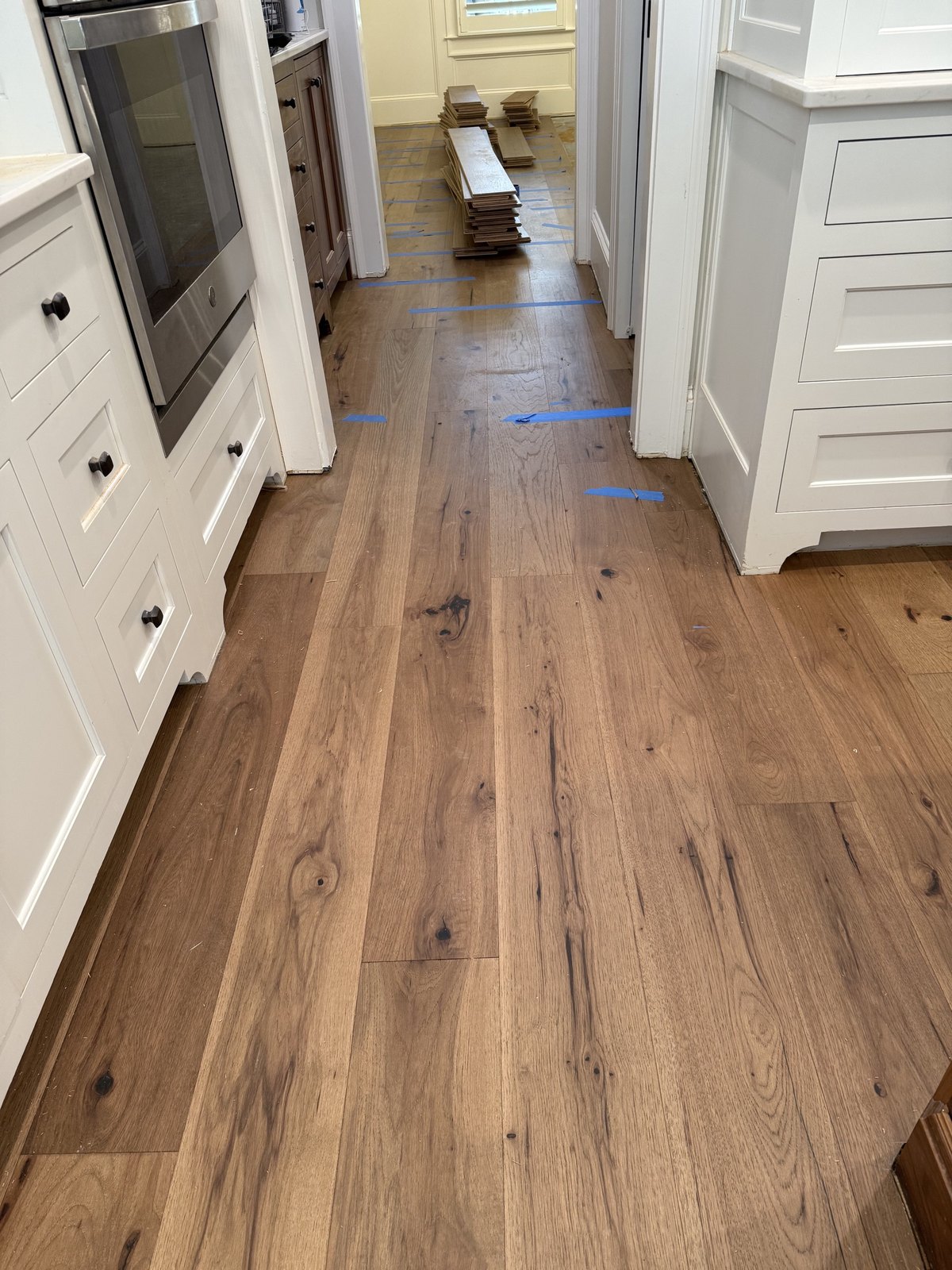
2026 pricing guide
How Much Does Flooring Installation Cost in Alpharetta, GA? (2026)
Last updated: July 8, 2026 · Ranges reflect the Atlanta metro market; sources at the end of this guide.
Flooring installation in Alpharetta costs about $5 to $15 per square foot installed in 2026, and the material drives most of that spread: quality LVP runs $5–12 per square foot, carpet $5–8, and hardwood $6–15 — engineered planks near the bottom of the hardwood range, site-finished wide-plank white oak at the top. Atlanta cost data puts most single-area projects between roughly $2,400 and $6,800, with an average around $4,350, while a full 2,000-square-foot main level in hardwood can reach $12,000–$30,000. Beyond the material, three line items move your number more than anything else: what has to come out first (tear-out and haul-away), what the subfloor needs (leveling adds about $2–3 per square foot), and how the new floor goes down (nail-down, glue-down, or floating). This guide itemizes every line you should see on a written bid, so you can check any quote — including ours — against the same math.
Quick reference
Installed cost by material tier
Materials and labor are shown separately where the market quotes them separately, because that split is the first thing to check on any bid. Installed totals are what most Alpharetta homeowners actually pay per square foot, before extras like stairs and transitions.
| Material tier | Materials only (per sq ft) | Labor (per sq ft) | Installed total (per sq ft) |
|---|---|---|---|
| LVP, 12-mil wear layer (mid-range) | $2.50–4.00 | $2.50–5.75 | $5–9 |
| LVP, 20-mil wear layer (premium) | $4.00–7.00 | $2.50–6.00 | $7–12 |
| Carpet, mid-grade with pad | Usually quoted bundled with pad and labor | $5–8 most jobs | |
| Engineered hardwood | National calculators: $9–20 installed | $6–12 typical here | |
| Solid red oak | $3–6 | $3–6 nail-down | $6–13 |
| Solid white oak | $4–7 | $3–6 nail-down | $8–15 |
| Wide-plank premium white oak, site-finished | $6+ | Nail-down labor plus $3–5 finishing | $12–15 and up |
Free download
The 2026 North Atlanta Flooring Pricing Guide
This guide’s tables plus the installation side, in a five-page PDF you can hand to your spouse — or to the next contractor who bids your job.
Installed cost by home size
Straight multiplication of the installed ranges above — before tear-out, subfloor work, stairs, and trim, which the line items below price out. Atlanta cost data shows most homeowners spend $2,377–$6,798 per project, averaging about $4,351, because most projects cover one area rather than a whole level.
| Area | Carpet ($5–8) | LVP ($5–12) | Hardwood ($6–15) |
|---|---|---|---|
| 500 sq ft (a large room or two bedrooms) | $2,500–4,000 | $2,500–6,000 | $3,000–7,500 |
| 800 sq ft (typical main-level common areas) | $4,000–6,400 | $4,000–9,600 | $4,800–12,000 |
| 1,200 sq ft (full main level, smaller plan) | $6,000–9,600 | $6,000–14,400 | $7,200–18,000 |
| 2,000 sq ft (whole level or main + upstairs) | $10,000–16,000 | $10,000–24,000 | $12,000–30,000 |
Line by line
What is actually on a flooring installation bid — 12 line items
Most quote shock comes from lines a low bid quietly left off. Our estimates itemize every one of these, with contingencies priced up front, so a surprise under the old carpet changes a line item you already saw — not the whole deal. Here is each line, its 2026 range, and what moves the number.
1. Tear-out and haul-away
Carpet: $0.40–0.50 per sq ft · Glued wood or tile: $1–4 per sq ft
Carpet removal and disposal is cheap — most projects run $120–720, averaging around $280 — because carpet rolls up. Glued-down wood, tile, and older multi-layer floors fight back, which is why their tear-out costs up to ten times more per foot.
What moves the number: glue-down versus stapled installs, tile with mortar beds, multiple existing layers, and disposal volume. A bid that shows no tear-out line at all is a bid that will grow later.
2. Subfloor repair and leveling
Leveling: about $2–3 per sq ft where needed
This is the most common source of mid-job price jumps in the Atlanta market, and the most avoidable. Wood planks and rigid LVP both telegraph dips and humps, so out-of-flat areas get ground or filled before anything goes down. Localized plywood repairs — soft spots, water damage at doors and baths — are priced separately per patch.
What moves the number: the age of the house, past leaks, and how much of the area is out of flat. We check the subfloor at the consultation and price the contingency up front rather than discovering it on day one.
3. Moisture testing on Georgia slabs
A small line item — insist on it before any glue-down over concrete
Much of North Fulton is built slab-on-grade or over finished basements, and Georgia’s humid climate means concrete can hold and transmit moisture long after it looks dry. Industry practice is to test the slab — a relative-humidity probe or calcium chloride test — before gluing wood or vinyl to it, because adhesive failure and cupped planks cost far more than the test ever will.
What moves the number: slab area and the number of test locations. The real question for any bidder is simpler: ask which moisture test they run and where the reading will appear in writing. If the answer is a shrug, keep interviewing.
4. Installation labor: nail-down vs glue-down vs floating
Hardwood nail-down: $3–6 per sq ft · Hardwood glue-down: $4–8 plus $3–5 adhesive · LVP click-lock: $2.50–5.75 · LVP glue-down: $3.50–9.20
How the floor attaches is a bigger cost lever than most homeowners expect. Nail-down is the standard for solid hardwood over a wood subfloor. Over concrete, hardwood must be glued (or switched to a floating engineered product), and adhesive is a real materials line of its own. Floating click-lock LVP is the fastest install; glue-down LVP costs more in labor but feels more solid underfoot and is the usual call for commercial-grade durability.
What moves the number: concrete versus wood subfloor, diagonal or herringbone patterns, and chopped-up floor plans with lots of closets and doorways versus open rectangles.
5. Wood materials: red oak vs white oak vs engineered
Red oak: $3–6 per sq ft · White oak: $4–7 · Engineered: $9–20 installed by national calculators
Red oak is the workhorse — the least expensive solid hardwood and the species already in most 1990s–2000s North Fulton homes, which matters when you are extending existing floors. White oak costs about a dollar more per foot and is what most buyers now ask for by name: neutral undertones, tighter grain, no pink cast. Engineered hardwood puts a real wood veneer over a stable core, which is why it is the wood option for slabs and basements where solid planks are risky.
What moves the number: plank width (7–10 inch wide plank costs more per foot than 2¼–5 inch), grade (clear versus character with knots), and veneer thickness on engineered products — a thicker veneer can be refinished later; a paper-thin one cannot.
6. LVP wear layers: 12-mil vs 20-mil
12-mil material: $2.50–4.00 per sq ft · 20-mil and up: $4.00–7.00
The wear layer — measured in mils, not millimeters — is the clear coat that decides how LVP survives dogs, chairs, and grit. A 12-mil layer is the residential standard and fine for bedrooms and low-traffic areas. For a main level with kids and a dog, 20-mil is the sweet spot most flooring pros recommend, and the price difference on 800 square feet is often smaller than one furniture repair.
What moves the number: wear-layer thickness, core type (rigid SPC versus cushioned WPC), and attached underlayment. Get the mil number in writing on the quote — “commercial grade” without a number is a marketing phrase, not a spec.
7. Site-finished vs prefinished hardwood
Site finishing adds about $3–5 per sq ft in sanding and finish labor
Prefinished planks arrive with a factory finish: faster install, no dust or fumes, walk on it the same day. Site-finished floors are sanded and finished in place, which adds $3–5 per square foot and several days — and buys you a perfectly flush, seamless surface, any custom stain, and the only honest way to match new wood to existing floors. Our sanding is dust-contained, and stain samples go on your actual boards, in your light, before finish day.
What moves the number: finish system (water-based versus oil-based), number of coats, and stain work. If matching existing floors matters to you, budget site-finished — a prefinished “close enough” is how transitions end up sticking out like a sore thumb.
8. Transitions, reducers, and thresholds
Priced per piece — count your doorways before you compare bids
Every place the new floor meets tile, carpet, or a different height needs a transition piece: T-molding, reducers, stair nosing, thresholds. Each is a small charge, but a main level can need a dozen, and they are a favorite omission of lowball bids. Height differences matter most when new flooring goes over an existing layer — a quarter inch at every doorway is something you feel every day.
What moves the number: the count of doorways and material changes, custom-milled versus stock pieces, and whether transitions are color-matched to a site-applied stain.
9. Stairs
$100–250 per step installed · Typical 12-step staircase: $1,250–$3,300
Stairs are quoted per step, not per square foot, and they punch far above their area — they are also the first thing guests and buyers touch. Carpet-to-hardwood conversions involve new treads or overlay systems, risers, and nosing work. Stairs are where vinyl plank is least forgiving, which is why many installers steer staircases to hardwood treads even in an LVP house.
What moves the number: full new treads versus overlay, landings, railing and baluster work, and open-sided stairs. The nosing and bullnose plan — including whether any existing nosing gets cut back — should be explained and put in writing before work starts.
10. Baseboards and shoe molding
Priced per linear foot — ask whether the bid reuses, replaces, or adds shoe
New flooring changes floor height, so the trim line has to be handled one of three ways: pull and reinstall the existing baseboards, add shoe molding (quarter round) to cover the gap, or install new baseboards. Reused trim is cheapest but shows its age next to a new floor; new paint-grade base with a caulked, painted finish is the furniture-showroom look — and since paint is on our contract too, the touch-up does not require scheduling a second company.
What moves the number: linear footage, trim profile, paint-grade versus stained hardwood shoe, and how many rooms need repainting at the base after install.
11. Furniture moving
Often billed per room — or eliminated entirely by empty-house timing
Installers typically charge to move furniture room to room, and heavy items — pianos, aquariums, packed bookcases — are usually excluded or billed separately. Ask how furniture handling is priced before comparing totals. The cheapest furniture line is the one that does not exist: flooring installed between closing and move-in day, in an empty house, avoids the charge and days of shuffling.
What moves the number: how full the rooms are, appliance disconnects and reconnects, and whether the job can be staged one level at a time.
12. Acclimation and Georgia humidity
Costs days on the schedule, not dollars on the bid — skipping it costs both
Hardwood needs to sit in your home and reach equilibrium with its humidity before installation, and in Georgia’s climate that step is not optional. Wide-plank floors installed straight off the truck are the ones that develop seasonal gaps when the heat comes on in winter. A written schedule should show acclimation days for wood products, plus HVAC running at normal living conditions during and after the install.
What moves the number: nothing directly — but a bid whose timeline has no acclimation window on solid hardwood is telling you how the job will be run.
The decision most homeowners are weighing
LVP vs hardwood: which is better for resale value in the Atlanta suburbs?
For resale in North Atlanta’s $600K-plus suburbs — Alpharetta, Milton, Johns Creek, Roswell — hardwood usually carries more weight with buyers, because it can be refinished for decades while a vinyl plank floor is replaced when its wear layer goes. Installed hardwood runs $6–15 per square foot here versus $5–12 for quality LVP, so the resale-oriented choice is often a smaller premium than homeowners expect, and refinishing later costs just $3–8 per square foot instead of a new floor. LVP is still the better call for basements, laundry areas, and rental properties, where waterproofing beats prestige, and a 20-mil wear layer handles kids and dogs without worry. We install both, so the consultation is about which rooms in your house call for which floor — not about selling you either one.
| Choose hardwood when… | Choose LVP when… |
|---|---|
| You plan to own for years or sell in a $600K+ market where buyers ask about wood by name | The room is a basement, laundry, mudroom, or bath — anywhere standing water is a real possibility |
| You want a floor that can be re-styled by refinishing ($3–8/sq ft) instead of replaced | Kids, dogs, and spills are daily life and you want a 20-mil wear layer doing the worrying |
| You are extending or matching existing site-finished oak | The subfloor is a slab and you want wood looks without glue-down hardwood costs |
| The budget clears $6–15/sq ft installed for the areas that show | The budget is $5–12/sq ft installed and the whole level needs doing at once |
Solid hardwood and standing water do not mix, and a thin wear layer was never built for a dog — those are the only two hard rules. Everything else is room-by-room judgment, which is what the free consultation is for.
Local pricing reality
What makes flooring costs higher in Alpharetta and North Fulton
The Atlanta metro averages hide the fact that North Fulton jobs skew toward the top half of every range, for reasons you can see from the street. Homes here are larger — open-plan main levels of 1,200–2,000 square feet are common, and big continuous areas mean more material, more transitions, and more staircases per project. Buyer expectations run higher too: in a market where typical home values sit between roughly $607,000 in Roswell and $860,000 in Milton, the requested spec is wide-plank white oak, site finishes, and matte sheens — the top of the materials table, not the bottom. Add the construction realities of the area — finished basements on concrete slabs that demand moisture testing and glue-down or floating installs, two-story foyers with open-sided staircases, and gated-community logistics that shape delivery and work hours — and a North Fulton bid is rarely the national average bid.
We quote against the same published ranges everywhere we work. Our service area covers Alpharetta, Milton, Johns Creek, Roswell, and Cumming — including the communities we are asked about most: Windward, the Avalon area, Downtown Alpharetta, Glen Abbey, and Ammersee Lakes in Alpharetta; Crabapple, Crooked Creek, White Columns, and The Manor Golf and Country Club on the Milton side; Country Club of the South, St Ives Country Club, The Falls of Autry Mill, Medlock Bridge, and Rivermont in Johns Creek; Horseshoe Bend, Willow Springs, and Brookfield Country Club in Roswell; and Vickery, Polo Golf and Country Club, St Marlo, and Laurel Springs toward Cumming and South Forsyth. Whatever the neighborhood, the bid format is identical: every line item above, itemized, with contingencies priced before work starts.
Before you replace anything
Replace, refinish, or overlay — the honest comparison
If there is existing hardwood in the house — including under carpet, where 1990s–2000s North Fulton homes often hide it — replacement is not automatically the answer. Refinishing costs roughly half of new installation and keeps wood that is often better than what would replace it. Here is the three-way comparison we walk through at consultations.
| Option | 2026 installed cost | Best when | Watch out for |
|---|---|---|---|
| Refinish existing hardwood | $3–8 per sq ft | The boards are sound and you want new color, sheen, or repairs — at half the cost of new floors | Deep pet stains and repeated past sandings limit what refinishing can fix; we tell you at the consultation, not after tear-out |
| New hardwood installation | $6–15 per sq ft | There is no wood to save, you are changing species or width, or you want one matched floor across the level | Tear-out, subfloor, and transition lines — make sure every bid includes them |
| LVP over an existing floor | $5–12 per sq ft | The existing floor is flat, dry, and not worth saving, and you want waterproof durability without full tear-out | Floor height rises at every doorway and appliance; and if refinishable hardwood is underneath, weigh refinishing first — covering it is hard to undo cheaply |
The honest version of this advice sometimes costs us a bigger job. If your floors are worth refinishing instead of replacing, we say so — that is what the refinishing guide and its ranges are for.
Resale math
Does new flooring pay you back at resale?
Floors and paint are consistently the pre-listing projects local agents push hardest, because buyers judge them in the first ten seconds of a showing — before the kitchen, before the yard. In North Fulton’s price band, listings compete on move-in readiness: a buyer stretching to $700,000 does not want to budget another flooring project, and worn floors read as a price-reduction argument. Sellers in online real-estate communities routinely credit redone floors for stronger offers, with some reporting sales well over asking that they attribute partly to the floors — a buyer outcome we can point to, not a guarantee anyone can make.
The math favors doing the work at these prices. An 800-square-foot main level refinished at $3–8 per square foot is $2,400–$6,400; the same area in new LVP is $4,000–$9,600, and in new hardwood $4,800–$12,000. Any of those is a fraction of a single price reduction on a $650,000 house. Material choice matters for the audience: in this market, hardwood — refinished or new — tends to carry the most weight with buyers, while fresh, quality LVP is a strong move-in-ready signal in basements and secondary spaces. And if your floors are actually fine as they are, we will tell you that too, because a consultation that saves you money is cheaper for everyone than a project that should not happen.
Budgeting advice
How to budget a flooring project without getting burned
Carry a 20% buffer. Not because prices are random, but because tear-out occasionally reveals what no estimate can see — a soft subfloor under the dishwasher, moisture at the slab, damage under old carpet. If the bid already itemizes those contingencies, the buffer usually goes unspent. If the bid is one round number, the buffer is where that number was always headed.
Treat the cheapest bid as a question, not an answer. When one quote lands far below the ranges in this guide, something is missing: tear-out, leveling, transitions, stair work, adhesive, or the moisture test. Ask the low bidder to itemize against the twelve line items above. A legitimate sharp price survives that conversation; a teaser price does not. Our own promise works the same direction — a comparable written quote lower than ours gets beaten by 5%, and “comparable” means the same line items are actually in it.
Specify in writing, in spec language. For LVP: wear layer in mils (12 versus 20), core type, and attached pad — not “commercial grade.” For hardwood: species, grade, plank width, and whether finishing is factory or on site. For stairs: the tread, riser, and nosing plan. For any glue-down over concrete: which moisture test, and where the reading appears. A bid written in specs can be compared and enforced; a bid written in adjectives cannot.
Time the project to the calendar you already have. The empty-house window between closing and move-in is the cheapest, fastest version of every flooring project — no furniture moving, no living around wet finish, and floors, stairs, and paint can run on one contract and one schedule keyed to the day the truck arrives.
Straight answers
Flooring installation cost questions, answered
Is this a fair quote for a flooring installation job?
Check it against the Atlanta ranges we price from: hardwood installation $6–15 per square foot, LVP $5–12, carpet $5–8, and stairs at $100–250 per step. A fair installation quote itemizes tear-out, subfloor work, materials by name, labor by method, transitions, and stairs — so a discovered problem changes a line item, not the whole deal. If a comparable written quote comes in lower than ours, we beat it by 5%.
How much does it cost to replace carpeted stairs with wood?
Plan on $100–250 per step installed, so a typical 12-step staircase runs $1,250–$3,300. Tread material, landings, railings, and balusters move the number within that range. Stairs are the first thing guests and buyers touch, which is why they punch above their square footage.
LVP or hardwood — which is better for my home?
The room decides. In North Atlanta’s $600K-plus suburbs, hardwood ($6–15 per square foot installed) is the resale-weight choice because it can be sanded and refinished for decades, while a vinyl plank floor gets replaced once its wear layer is done. Quality LVP ($5–12 installed) earns its keep in basements, laundry rooms, and baths — anywhere waterproofing matters more than prestige, or where a 20-mil wear layer needs to shrug off kids and dogs. Since we install both, the consultation is a walk through your rooms, not a pitch for either product.
Can flooring and painting be done before move-in?
Yes — the empty-house window between closing and moving day is the ideal time, and it is the strongest reason to use one contractor instead of sequencing two or three. One contract covers floors, stairs, and paint on one schedule keyed to your move-in date, and installation is simpler in an empty house because nobody is shuffling furniture room to room.
Can one contractor handle floors, kitchen, bath, and paint together?
It can, and scheduling is the reason to want it. With one-stop general contracting there is a single consultation, a single contract, and a single schedule across every trade, so a painter’s delay never wrecks a flooring start date. In the window between closing and move-in — the easiest time to do floors and paint — that coordination is usually worth more than any line-item saving.
How long does flooring installation take?
Most LVP and prefinished hardwood installations are measured in days, not weeks — small jobs sometimes finish in a single day, and a typical main level takes a few days once tear-out and prep are included. Site-finished hardwood adds a sanding and finishing phase comparable to a refinishing job, which averages 3–5 days. You get the day count in writing before work starts, keyed to your move-in or listing date if you have one.
No obligation — just real numbers
Get your project priced against these ranges
Bring us a floor plan sketch, a competing bid, or just a room count. We measure, check the subfloor, and hand you an itemized written proposal you can audit against every number on this page. If refinishing your existing hardwood is the smarter spend, that is what we will recommend — the refinishing cost guide shows that math too.
Sources and methodology
Every figure in this guide comes from published 2026 cost data, retrieved July 7, 2026, or is straight arithmetic on those figures (the home-size table multiplies per-square-foot ranges by area; installed placements for oak tiers position each species inside Atlanta’s $6–15 installed hardwood range using the materials-price differences cited below). Where Atlanta-specific data exists we use it; otherwise we use national 2026 figures and say so. Check our math against any bid you receive — including ours.
- Atlanta hardwood installation ($6–15/sq ft installed; most projects $2,377–$6,798, average ≈ $4,351; tear-out $1–4/sq ft): Angi, “How Much Does Hardwood Flooring Cost in Atlanta, GA?” — angi.com/articles/how-much-does-hardwood-flooring-cost/ga/atlanta
- Atlanta subfloor leveling ($2–3/sq ft) and install cost context: Peachy Floors, “Cost to Install Hardwood Floors in Atlanta” — peachyfloors.com/resources/cost-to-install-hardwood-floors-in-atlanta/
- Hardwood species materials pricing (red oak $3–6, white oak $4–7/sq ft), solid $11–25 and engineered $9–20 installed, site-finishing premium ($3–5/sq ft), nail-down labor $3–6 and glue-down $4–8 plus $3–5 adhesive: HomeGuide, “How Much Does Hardwood Flooring Cost? (2026)” — homeguide.com/costs/hardwood-flooring-cost
- LVP installed ranges ($5–12 most jobs; click-lock labor $2.50–5.75, glue-down $3.50–9.20): HomeGuide, “Luxury Vinyl Flooring Cost” — homeguide.com/costs/luxury-vinyl-flooring-cost; FlooringStores, “Cost of LVP Flooring” — flooringstores.com/a/blog/cost-of-lvp-flooring
- LVP wear-layer material tiers (12-mil $2.50–4.00, 20-mil+ $4.00–7.00/sq ft) and mid-range installed totals ($5–9): D and G Flooring, “Luxury Vinyl Plank Flooring Cost: Complete Price Guide for 2026” — dgfloors.com/luxury-vinyl-plank-flooring-cost/
- Carpet installation ($3–11/sq ft, most jobs $5–8): HomeGuide, “Carpet Installation Cost” — homeguide.com/costs/carpet-installation-cost
- Carpet removal and haul-away ($0.40–0.50/sq ft; $120–720 typical, ≈ $280 average): Angi, “How Much Does Carpet Removal Cost in 2026” — angi.com/articles/how-much-does-carpet-removal-cost.htm; HomeAdvisor, “How Much Does It Cost to Remove Carpet?” — homeadvisor.com/cost/flooring/carpet-removal/
- Stairs ($100–250/step; 12-step staircase $1,250–$3,300): Stair Creations, “Cost to Replace Carpet Stairs with Wood” — staircreations.com/post/cost-to-replace-carpet-stairs-with-wood/; HomeAdvisor, “Install Hardwood Stairs” — homeadvisor.com/cost/stairs-and-railings/install-hardwood-stairs/
- Hardwood refinishing comparison range ($3–8/sq ft, Atlanta): Angi, “Hardwood Floor Refinishing Cost, Atlanta” — angi.com/articles/hardwood-floor-refinishing-cost-and-other-factors/ga/atlanta; refinishing timeline (3–5 days): Angi, “How Long Does Refinishing Hardwood Floors Take” — angi.com/articles/how-long-does-refinishing-hardwood-floors-take.htm
- Concrete-slab moisture testing practice before glue-down installs: Wagner Meters, “Subfloor Preparation” — wagnermeters.com/moisture-meters/wood-info/subfloor-preparation/
- Home-value context (Roswell ≈ $607K, Alpharetta ≈ $656K, Johns Creek ≈ $651K, Milton ≈ $860K): Zillow Home Values, retrieved 2026 — zillow.com/home-values/