
Flooring Guide · Material Comparison
Hardwood vs Porcelain Tile for Alpharetta Main Living Areas
Last updated: July 8, 2026
Put simply: hardwood earns the living room, dining room, and bedrooms, where warmth, quiet, and refinish value matter most; porcelain tile earns the kitchen, entry, and mudroom, where water and grit arrive daily. Installed hardwood runs $6 to $15 per square foot in the Atlanta market and can be re-sanded at $3 to $8 per square foot for decades — the strongest argument for wood in rooms that stay dry.
Neither material is a mistake. They solve different problems, and most Alpharetta main levels end up using both — the real question is where the line between them falls in your floor plan.
Hardwood or porcelain tile — which belongs in your main living area?
Start with what the room absorbs in an ordinary week. If the space holds the sofa, the bookshelves, and the evening routine — and water only ever arrives by accident — hardwood is the better floor: it warms the room, muffles footsteps, and its $3 to $8 per square foot refinish path means the surface gets renewed instead of replaced for as long as you own the house. If the room is the landing zone for the garage door, the back door, or the kitchen sink, porcelain takes the pressure off: wet shoes, dropped cups, and pet bowls are a mop pass rather than a maintenance decision. We install both materials, which keeps the recommendation tied to the room rather than to a product line. The full cost picture for new floors is in our flooring installation cost guide.
The tradeoff, side by side
Every consultation about these two materials circles the same six questions. Here they are in one view.
| Factor | Hardwood | Porcelain tile |
|---|---|---|
| Feel underfoot | Warm, softer, quiets footsteps | Cool, firm, easy to keep crisp |
| Water and humidity | Wants prompt cleanup and stable conditions | Largely indifferent to spills and damp |
| Routine care | Sweep or vacuum; recoat every several years | Sweep and mop; grout needs periodic attention |
| Repairs | Boards spot-repair; whole floor refinishes at $3–8/sq ft | Cracked tiles are replaced individually — keep spares from the install |
| Long-term path | Sand and refinish for decades | Long service life on a properly prepared subfloor |
| Earns its place in | Living rooms, dining rooms, bedrooms | Kitchens, entries, mudrooms, baths |
The pattern most local homes land on is not either-or: wood carries the living spaces, tile carries the wet ones, and the transition lines get decided on purpose rather than by accident.
How each material lives day to day
What hardwood does for a living space
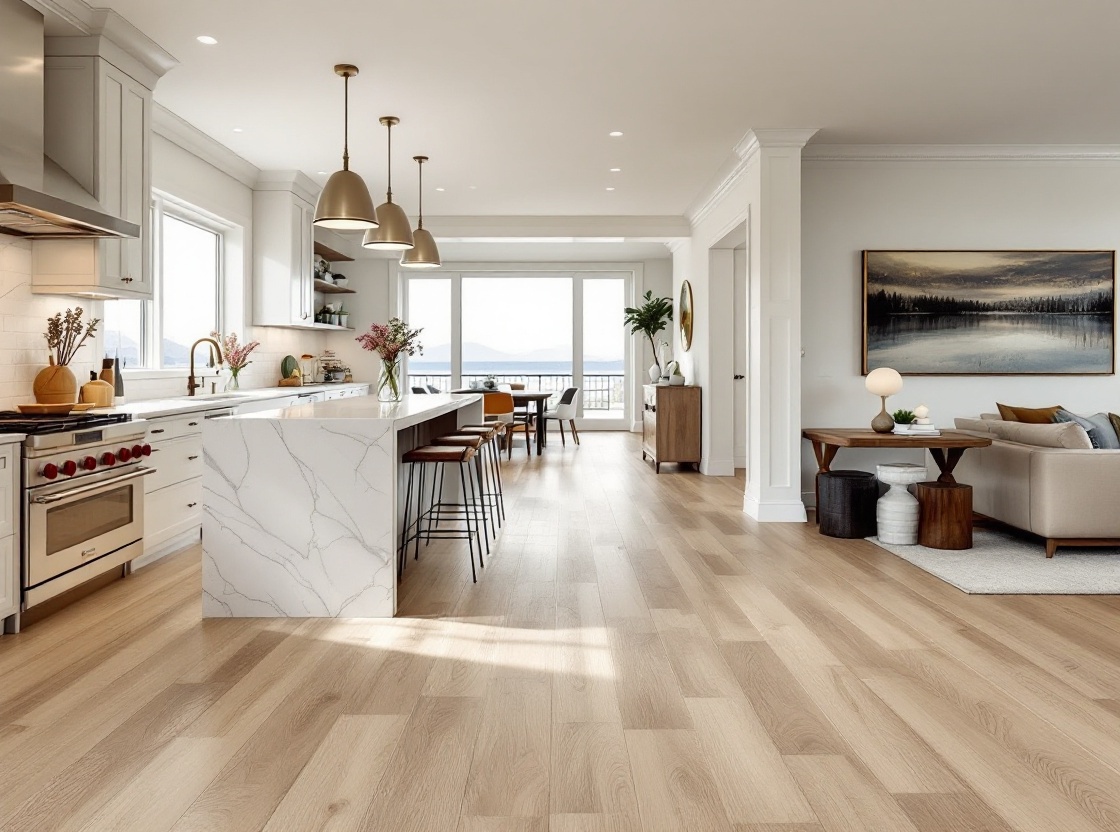
Hardwood softens a big open room — it absorbs a little sound, warms the light, and gives furniture something to sit on that does not feel institutional. On a January morning, bare feet notice the difference immediately. In open plans where a single surface carries the whole main level, that steady warmth does more work than most homeowners realize.
What porcelain brings to hard-use rooms
Porcelain holds its composure. The surface stays crisp under shoes, chair legs, pet claws, and dropped groceries, and a five-minute mop brings it back to day one. In homes where the living area flows straight into the kitchen or the entry, tile draws a clean, continuous line through the busiest path in the house.
Moisture, heat, and Georgia humidity
North Georgia summers push indoor humidity up, and wood responds — boards take on moisture and swell slightly in summer, then release it and open hairline seasonal gaps in winter. That is normal hardwood behavior, not a defect, and a proper installation plans for it: acclimating boards before the first one is fastened, leaving expansion room at the walls, and keeping the HVAC running through the seasons.
Porcelain sits out that cycle entirely. Humidity, spills, wet umbrellas, and the occasional pet accident change nothing about it, which is why it is the calm choice for rooms that connect to the outdoors or to plumbing. Near a back door or a kitchen sink, tile removes a whole category of worry.
Maintenance, repairs, and whole-home planning
Hardwood asks for more attention and repays it with options. A tired wood floor can be screened and recoated, or fully sanded and refinished at $3 to $8 per square foot — renewal instead of replacement, again and again. Tile asks for almost nothing day to day beyond grout care, but when its look ages out, the change means demolition rather than sanding.
Both materials are only as good as what sits underneath them. Tile especially telegraphs subfloor problems — a dip that wood would flex over becomes a cracked tile or a hollow spot. Leveling runs roughly $2 to $3 per square foot, and an estimate that inspects first and itemizes that prep keeps a discovered problem inside a line item you already saw.
The planning question grows when floors are part of a bigger project. If the kitchen, the stairs, or a bathroom is changing at the same time, sequencing every trade on one contract keeps transitions, trim heights, and material continuity coordinated — and leaves you exactly one number to call while it all happens.
Room by room: where each material earns its place
Living rooms and dining rooms lean hardwood because their job is comfort and continuity, not water resistance. In North Fulton’s open plans, one wood tone across the family room, hallway, and dining area makes the level feel larger and more settled.
Kitchens, entries, mudrooms, and laundry areas lean porcelain because their job is absorbing mess. A floor that shrugs off dishwasher drips and cleat grit takes real stress out of a busy week.
Stairs deserve their own line: hardwood treads matched to the main floor are the standard answer, and at $100 to $250 per step they are worth deciding early, since the staircase is the most touched and most photographed surface in the house. Mapping all of this room by room is what a flooring installation consultation is for.
Frequently asked questions
Can porcelain tile be installed over an uneven subfloor?
Not successfully. Tile is rigid, so dips and humps in the subfloor turn into cracked tiles and hollow spots later. Leveling typically adds about $2–3 per square foot and should appear as its own line in the estimate before work begins, so a discovered problem changes a number you already saw.
Is hardwood risky in a room that opens to the kitchen?
No — many Alpharetta open plans run hardwood through the kitchen and living space as one continuous floor. The trade is discipline: wipe standing water promptly and keep indoor humidity steady, and the floor rewards you with a surface that refinishes at $3–8 per square foot instead of being replaced.
Which choice helps more at resale?
In North Fulton listings, continuous hardwood through the main living spaces registers with buyers in the first seconds of a showing, while porcelain earns its credit in kitchens, baths, and entries, where buyers read it as durability. The combination — wood where the house lives, tile where the house works — is the pattern local listings favor.
The bottom line for Alpharetta main living areas
Hardwood wins where the room stays dry and comfort leads; porcelain wins where the room works hard and water is routine. Draw the boundary at the doorways where the traffic changes character, and both materials end up doing what each does best.
Get a room-by-room recommendation
A free in-home consultation walks your floor plan, checks the subfloor, and puts the whole project — materials, labor, prep — into one itemized proposal. If a comparable written quote comes in lower, we beat it by 5 percent.
Prefer to talk it through first? Call 470-352-1156 or email [email protected] — we reply within one business day.