
Floors · Stairs · Kitchen · Bath · Paint
Whole-home remodeling in Alpharetta — five trades, one contract.
Last updated: July 8, 2026
Five trades — flooring, stairs, kitchen, bath, and interior painting — run on a single schedule from a single accountable company. The version of this project everyone wishes they had booked is the one that finishes before the furniture arrives, and that window is exactly what we build schedules around.
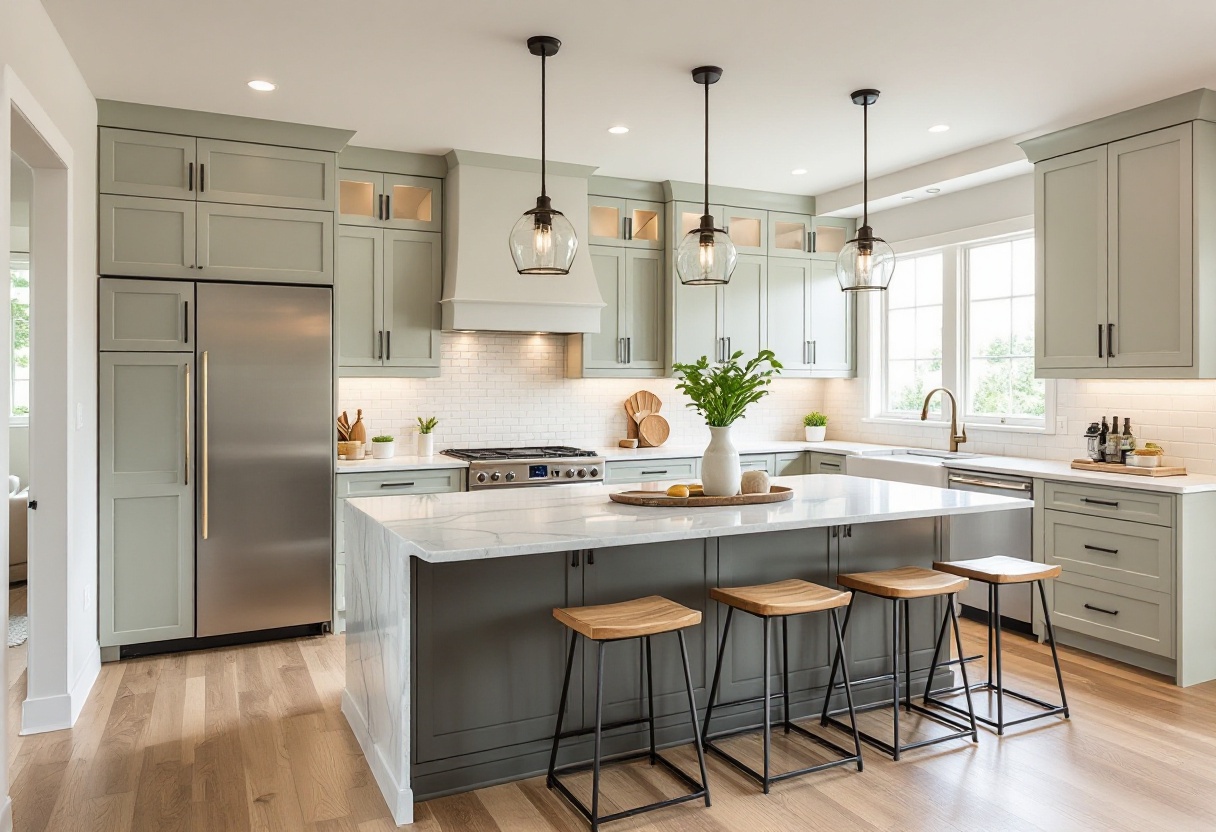
What does a combined floors-plus-paint remodel cost in Alpharetta?
Budget a combined project trade by trade, because that is how an honest proposal prices it. In 2026 Atlanta-market terms: refinishing existing hardwood runs $3–8 per square foot, new hardwood installation $6–15, LVP $5–12, carpet $5–8, and stair conversions $100–250 per step. Kitchen, bath, and interior painting scopes are measured on the same walkthrough and priced as their own sections of the same proposal — no blended lump sum. That structure is the point of one contract: you can trim a trade, phase it for later, or drop it entirely without renegotiating the rest of the project. The flooring numbers behind those ranges are published in our installation cost guide and refinishing cost guide, and the quote-beat promise carries over — show us a comparable written bid for the same scope and our price comes in 5% under it.
Why one contract
The three problems with hiring three contractors
The gap between trades
Your floor crew wraps on a Tuesday, but the painter you booked two months ago can’t start until the 28th — so the empty-house window you paid a premium to protect leaks away in dead days. On one contract the trades are booked as a single job, and the written day count covers the whole project, not one company’s slice of it.
The seam nobody owns
Where the painter’s caulk line meets the new baseboard, or the tile setter’s threshold meets the hardwood, three separate companies produce three separate explanations of whose problem it is. When every trade works for the same company, every handoff has one owner — and problems get fixed instead of narrated.
The second full-time job
Homeowners in online communities describe sequencing a flooring company, a painter, and a remodeler as a project-management job they never applied for. A combined contract hands that job back to us: one proposal, one point of contact, one paper trail — and one company whose name is on all of it.
Scope of a combined project
What one contract can cover
Flooring installation
Hardwood, LVP, and whatever the slab or subfloor underneath demands, at $5–15 per square foot installed depending on material.
Flooring installation →Sanding & refinishing
Existing hardwood brought back at $3–8 per square foot — usually the highest-return line on a combined project.
Sanding & refinishing →Stairs remodeling
Carpet-to-wood staircases at $100–250 per step — the piece guests and buyers touch before they see a single room.
Stairs remodeling →Carpet installation
Bedrooms, basements, and media rooms where soft flooring still wins, installed at $5–8 per square foot.
Carpet installation →Kitchen updates
Cabinet, counter, and layout work handled inside whole-home projects — sequenced with the floors instead of against them.
Kitchen remodeling →Bath & shower updates
Bath and shower scopes on the same proposal, so tile, thresholds, and adjoining floors get planned by one company.
Bathroom & shower remodeling →Interior painting is the sixth trade on the list, and it is priced only as part of combined projects like these — its role on this page is covered below, drips, sequencing, and all.
How a combined project runs
One walkthrough to one final walkthrough
Whole-scope visit
One appointment covers every room and every trade — floors, walls, stairs, kitchen, bath — measured together.
Selections at home
Plank and stain samples go down on your own boards, in your light, and finish decisions get made against the rooms they’ll live in.
One priced document
Each trade gets its own itemized section, demo through paint, so trimming a line never means redoing the deal.
Work in sequence
Demo and rough work first, floors next, paint last — one calendar with a written day count over all of it.
Room-by-room close
Every space gets checked against the proposal with you, and the punch list is finished before we call the job done.
The signature project
The closing-to-move-in package: done before the truck arrives
The most common combined project on our calendar starts with a set of new keys. The house is under contract or just closed, the moving truck is booked for next month, and the owners want the floors redone and every wall repainted before a single box comes through the door. Homeowners in online communities give the same two reasons again and again: they want it handled “before we move our furniture,” and all of this work is “so much easier when the place is empty.”
They are right on both counts. An empty house means no furniture to shuffle from room to room, no taped-off hallways to live around, and no curing finish to tiptoe past at night. Crews can hold entire levels at once instead of working around a household, which is why the same scope runs meaningfully faster in a vacant home than in a lived-in one — and why the work costs less stress at any price.
What makes the window dependable is the paperwork, not luck: before anything starts, you get the day count in writing, keyed to your move-in date. Many clients book the consultation while the house is still under contract, so the proposal is ready to sign at closing and the crew starts the same week the keys change hands.
The sixth trade
Interior painting, handled inside the same contract
Painting is part of our one-stop scope. On combined projects, interior painting is written into the same contract, the same proposal, and the same day count as the flooring and remodeling work — a line item we are accountable for, with the rest of the job.

Order matters more with paint than with any other trade on the job. When existing hardwood is being sanded and refinished, the machine work comes first and the walls are painted afterward, so fresh paint never sits through a sanding cycle — even a dust-contained one. When new flooring is going in, the sequence flips: walls are painted while the old floor is still down to absorb the drips, and baseboards, shoe molding, and door casings get their coats after the new floor is locked in. Ceilings, in either case, come before everything else.
That choreography is the quiet argument for one contract. Split across two companies, every handoff becomes a phone call, a gap week, and a debate about whose tape lifted whose finish. Inside one company, it is a line on Tuesday’s schedule.
The painting scope is held to the same walkthrough-and-punch-list standard as our flooring work.
Kitchens & baths, in context
Kitchens and baths as chapters of a whole-home project
Kitchen and bath work shows up here the way it shows up in real projects — as part of a whole-home scope where the new floor runs through the kitchen, the stair landing meets the upstairs hall, and the paint ties every room to one palette. The kitchen page and bath page cover those scopes in detail.

Sequencing is where a combined project earns its keep. Cabinets and site-finished hardwood have a strict order of operations, and a floating LVP floor must never be pinned under cabinet runs or a kitchen island — the floor has to move freely or its locking joints fail. Tile-to-wood thresholds get decided before demo rather than discovered after it, because a botched transition line is the detail that sticks out like a sore thumb for the next fifteen years. When the flooring company and the remodeling company are the same company, those decisions happen once, on paper, before anyone swings a hammer.
One honest boundary: if your project is a focused kitchen-and-bath-only remodel — no flooring, no paint, no stairs attached — that is our sister company’s entire specialty. Start with Alpharetta Kitchen & Bath instead.
Combined-project questions
What homeowners ask before signing one contract
Can one company handle flooring, painting, and a kitchen or bath update at the same time?
Yes — that is what one-stop general contracting means in practice. Every trade is scoped in the same walkthrough, priced in the same proposal, and run on the same calendar, so the painter is never waiting on a flooring company that answers to somebody else. When you interview any contractor, the useful test is simple: ask whether a single company is contractually responsible for every trade on the job, or whether you are really hiring yourself as the project manager.
How does scheduling work when several trades share one contract?
You get one written day count covering the whole project before work begins, not a separate estimate per trade. We sequence the trades internally — demolition and any kitchen or bath rough work first, flooring next, paint toward the end with touch-ups after — and because one company controls that order, a slow day in one trade gets absorbed inside the same calendar instead of cascading into another company’s backlog. If the project is tied to a move-in or listing date, the schedule is keyed to it.
Should you paint before or after new floors go in?
It depends on which floor. When hardwood is being sanded and refinished, the heavy machine work happens first and walls are painted afterward, so fresh paint never sits through a sanding cycle. When a new floor is being installed, the order flips: walls get painted while the old floor is still down to catch any drips, and baseboards, shoe molding, and touch-ups come after the install. On a combined contract you never have to referee that order — it is decided once and written into the schedule.
What should you budget for a floors-plus-paint project before move-in?
Build the budget trade by trade, starting with flooring because it is usually the largest line: refinishing existing hardwood runs $3–8 per square foot in 2026, new hardwood $6–15, LVP $5–12, carpet $5–8, and stairs $100–250 per step. Interior painting is measured and priced as its own section of the same proposal rather than blended into a lump sum, so you can see exactly what the paint scope adds — and trim or phase it if the total crowds your budget.
From the blog
What our customers read next
One call covers every trade
Start with the whole-house conversation
Bring the closing date, the room list, and every maybe on it — flooring, stairs, paint, kitchen, bath. You hear back within one business day with per-trade numbers to react to, not a lump sum to take or leave. Call 470-352-1156 or email [email protected].