
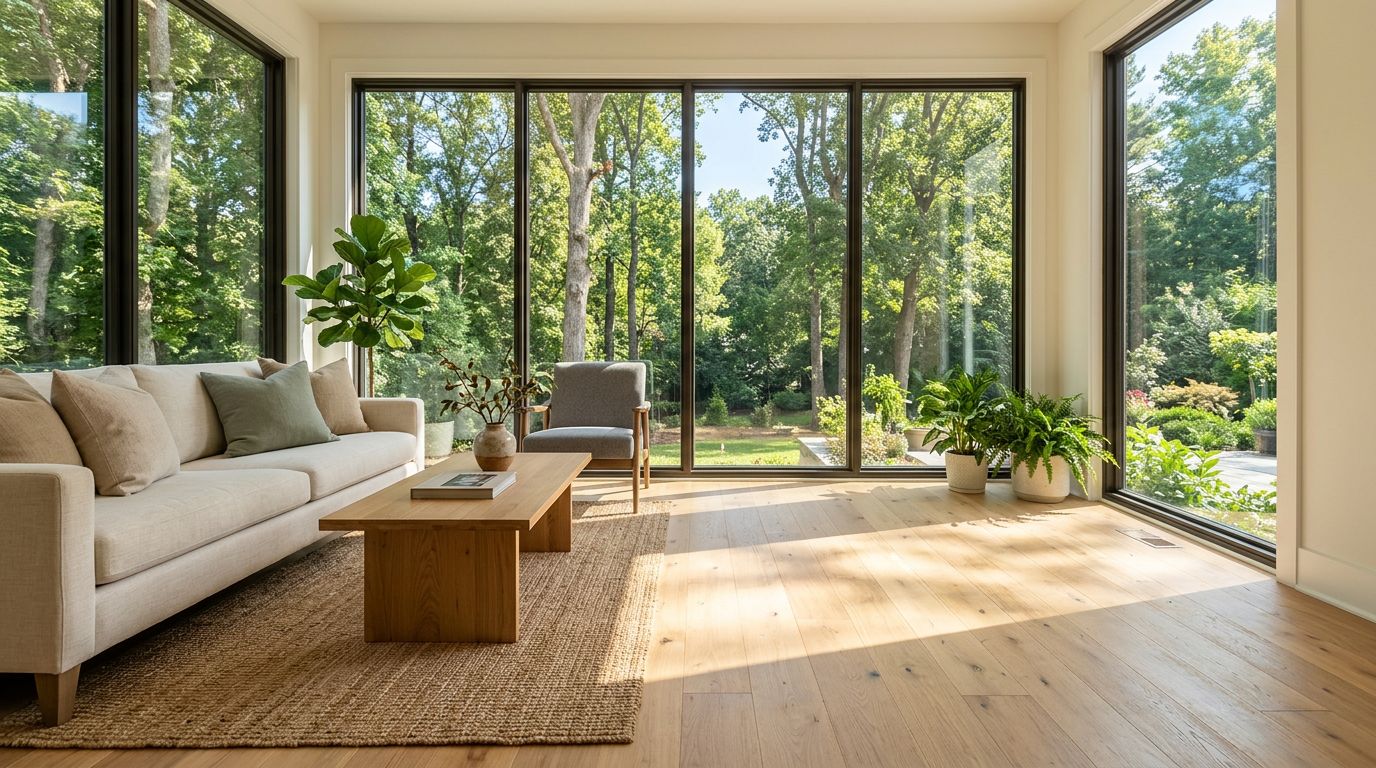
A sunroom can feel calm in the morning and harsh by late afternoon. In Alpharetta, those swings put far more stress on a floor than most indoor spaces.
When we choose sunroom flooring in Alpharetta, we look past color first. The best floor has to stay stable through heat, sunlight, humidity, and cool winter mornings, or the room will show problems long before the rest of the house does.
That is where material choice and installation detail matter most.
Why Alpharetta sunrooms are harder on floors
Sunrooms take a daily beating from glass, light, and fast temperature change. Even when the rest of the home feels steady, a sunroom can heat up quickly, then cool off after sunset.
That cycle makes flooring expand and contract more than usual. If the material is sensitive, boards may gap, edges may lift, and finishes may wear faster near the windows. On slab-based sunrooms, moisture can add another layer of stress.
We see the biggest issues in enclosed porches and three-season rooms. Those spaces often lack the steady climate control that helps standard indoor flooring behave. A fully conditioned four-season sunroom gives us more options, but the room still gets stronger UV exposure and more surface heat than a typical den.
Before we recommend any product, we ask a simple question: how does the room act in July and January? If it gets hot enough to warm the floor through bare feet, that matters. If condensation forms near doors or windows, that matters too.
A good floor in this space needs more than a nice finish. It needs dimensional stability, moisture resistance, and an installation plan that leaves room for movement. That is why many broad flooring rules do not hold up in sunrooms.
In a sunroom, movement matters as much as appearance.
If you have been reading general advice online, you have likely noticed a pattern. Many guides, including this overview of sunroom flooring options by climate, favor materials that can tolerate heat and moisture. Real-world homeowner discussions on wide temperature swings in sunrooms often reach the same conclusion.
Best flooring choices for sunrooms in Alpharetta
For most homes, three materials rise to the top. The best fit depends on how the room is built and how closely it matches the rest of the house.
| Flooring type | Best for | Main strengths | Main concern |
|---|---|---|---|
| Luxury vinyl plank | Most sunrooms, active households | Handles movement well, easy care, softer underfoot | Lower-end products can fade or deform in heavy heat |
| Porcelain tile | Sunrooms on slab, rooms with strong sun or moisture | Highly stable, water-resistant, scratch-resistant | Feels harder and cooler underfoot |
| Engineered hardwood | Climate-controlled sunrooms that connect to main living areas | Warm, upscale look, better stability than solid wood | Still needs careful product choice and sun control |
For many homeowners, LVP is the best all-around answer. Tile is the toughest option. Engineered wood works when visual continuity matters and the room stays well controlled.
Luxury vinyl plank gives the best balance
We often recommend luxury vinyl plank first because it handles daily expansion better than many other wood-look floors. It also resists tracked-in water, pet traffic, and dirt from exterior doors.
The better products have a stable core, a durable wear layer, and locking systems built for residential movement. That matters in a room that heats up fast by the windows. Even so, we avoid bargain-grade products in bright sunrooms because low-cost planks can telegraph heat stress sooner.
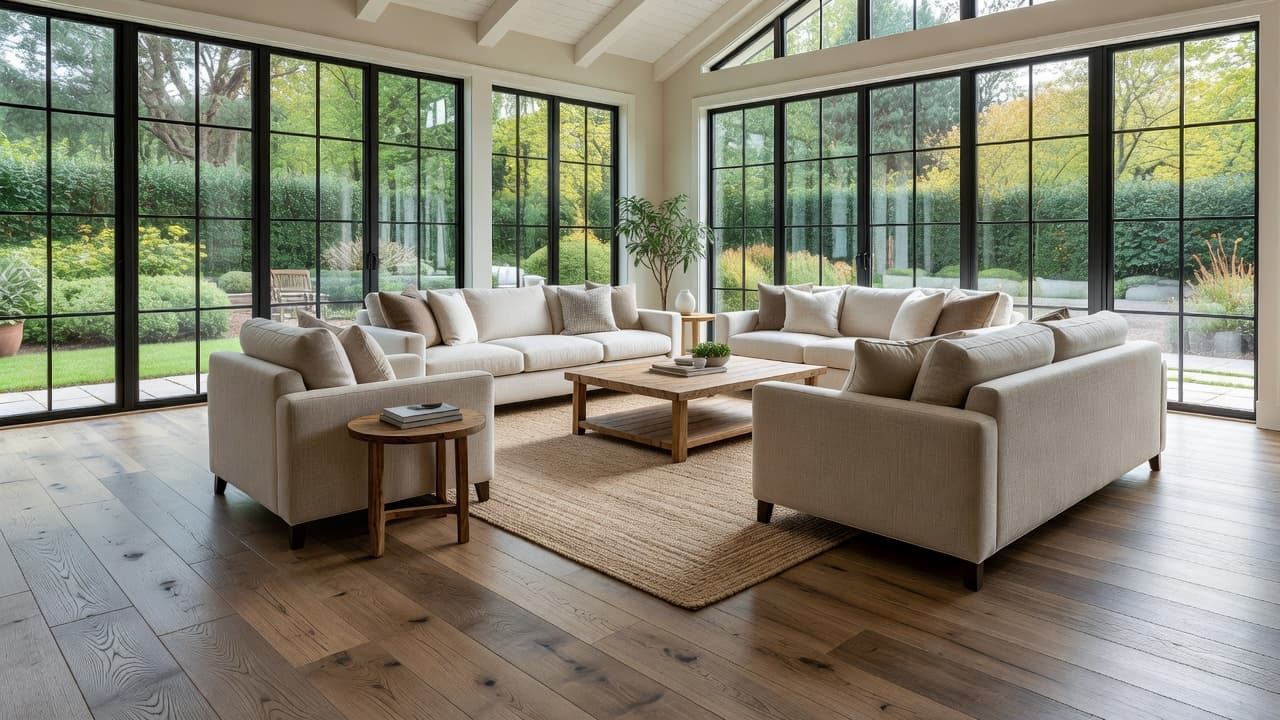
LVP also solves a comfort issue. It feels less cold than tile, and it gives a softer step for spaces used as reading rooms, casual sitting areas, or play zones. In Alpharetta homes where the sunroom opens straight into the kitchen or living room, wood-look vinyl often blends well without demanding hardwood-level care.
Porcelain tile wins in the toughest conditions
If the room sits on concrete and gets strong sunlight, porcelain tile is hard to beat. It does not swell like wood-based products, and it shrugs off wet shoes, plant watering, and humidity.
We like tile for sunrooms that double as mudrooms, pet spaces, or garden rooms. It also works well where homeowners want a cooler surface in summer. Large-format tile can make the room look clean and bright, while textured tile adds grip near exterior doors.
The catch is comfort. Tile is harder underfoot, and in cooler months it can feel cold unless the room gets strong sun or radiant heat. The floor below also has to be flat, and the installer has to account for slab movement. A beautiful tile job can still crack if the prep is wrong.
Engineered hardwood works in the right room
Engineered hardwood is the best wood option for a true four-season sunroom. It offers the warmth many homeowners want, especially when the sunroom opens to existing wood floors.
We only like it when the room is climate-controlled and the product is rated for that setting. The core construction matters. So does plank width. In many sunrooms, a more stable engineered product with a modest plank width performs better than a wide plank chosen only for style.
Solid hardwood is usually the wrong bet here. It is more likely to react to swings in heat and humidity. If the goal is real wood character without inviting movement problems, engineered wood gives us a safer middle ground.
Floors that often fail, and the install details that decide the outcome
The flooring that disappoints most often is solid hardwood. It looks right on a sample board, but sunrooms are not sample-board rooms. They are high-light, high-movement spaces.
Cheap laminate can also struggle when sun, humidity, and minor water exposure collide. Carpet tends to trap dirt and moisture, and it is rarely the best long-term match for a room that bridges indoors and outdoors. Peel-and-stick products may look like a low-risk shortcut, but heat near glass can expose every weakness.
Still, product choice is only half the job. Many failures start below the surface. We test slab moisture. We check flatness. We leave the right expansion space. We plan transitions so the floor can move without pinching at doors or walls.
Window placement matters too. South-facing walls can heat a section of floor far more than the center of the room. In those rooms, shade, UV film, or interior blinds can help protect the finish and reduce uneven heating.
We would rather talk a homeowner out of the wrong floor than install one that fights the room every day. A sunroom rewards caution. It also rewards good prep.
Match the sunroom floor to the rest of the home
A sunroom rarely stands alone. It often opens off a kitchen, family room, stair hall, or finished basement, so the floor decision affects more than one space.
Many homeowners first reach us after searching for a “local hardwood flooring contractor in Alpharetta Ga”. Soon after, the project expands. They may also need a “top hardwood floor sanding contractor in Alpharetta”, a “tile installation company Alpharetta”, a “Stair remodeling company Alpharetta”, a “local stair contractor alpharetta”, or even a “local basement finishing contractor in alpharetta and milton” when the same material direction continues through the house.
The same thing happens with remodel planning. If the sunroom sits off the kitchen, homeowners often compare the “best local kitchen remodeling contractor in Alpharetta” and a “Local kitchen remodeling contractor in Alpharetta” before they settle on one flooring palette. If the nearby bath or laundry room also needs work, they may be looking for a “local bathroom remodeling contractor in Alpharetta and Milton” at the same time.
That broader view usually leads to a better result. A floor should make the sunroom feel connected, not tacked on. For homeowners weighing the options, our expert flooring installation services and professional flooring services in Alpharetta help us plan the material, transition details, and finish level together.
If you want a room-by-room recommendation, call us at 470-352-1156 for a free estimate. If you show us a comparable written quote from another contractor, we beat it by 5%.
Final thoughts
The best floor for a sunroom is the one that fits the room’s behavior, not the one that looks best under showroom lighting. In most Alpharetta homes, that means LVP for balance, porcelain tile for the hardest use, and engineered hardwood only when the room stays controlled.
When we choose stable materials and install them with room to move, the floor lasts longer and looks better. That is the difference between a sunroom that ages well and one that starts showing stress at the windows first.