
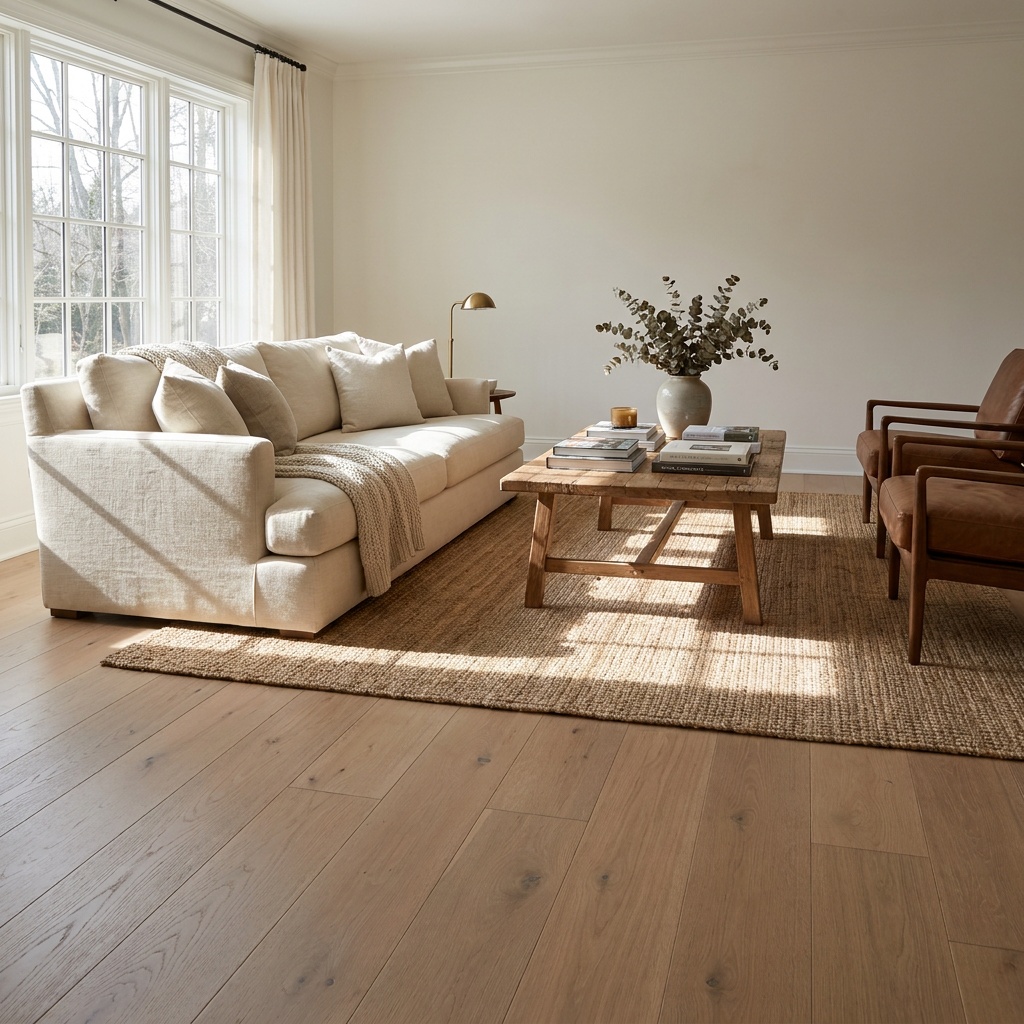
Site-finished hardwood is sanded and coated with polyurethane in your home, giving a seamless surface but more dust and a longer wait before furniture goes back. Prefinished hardwood arrives factory-coated, so there’s no sanding dust and you can walk on it the same day, but you’ll see a slight bevel at each board edge. Neither is wrong. The right pick depends on how much you value a flawless surface versus a fast turnaround.
What “site-finished” and “prefinished” actually mean
Site-finished floors are unfinished boards nailed or glued down, then sanded flat and coated on location. The finish cures as one continuous film across the whole room.
Prefinished boards get their stain and topcoat at the factory, cured under UV lights in a controlled setting. They arrive ready to install, coat already hardened.
Both start with real wood, solid or engineered. The difference is where the finishing happens, and that changes almost everything downstream — dust, timeline, and appearance. Our flooring installation team handles both, so the choice comes down to your project, not our capability.
Dust: what to actually expect
Site-finishing means sanding in place. That’s the source of the dust conversation. A three-pass sanding sequence — coarse grit around 36, then 60 or 80, then a finish pass at 100 to 120 — removes the mill glaze and any old finish before stain and topcoat go on.
Modern dust-contained sanding equipment captures the bulk of that debris at the source instead of letting it settle on cabinets and countertops. It’s a real improvement over the drum sanders of a decade ago, but some fine dust still finds its way into adjoining rooms during a whole-house refinish.
Prefinished flooring skips this step entirely on install day. There’s no sanding, no stain smell, and no fine dust settling on your kitchen counters. If your household includes someone with dust sensitivity, or you’re refinishing while living in the home, that’s a meaningful difference.
Cure time: the part people underestimate
Site-finished floors need real cure time, not just dry time. Oil-based polyurethane is typically dry to the touch in 8 to 12 hours between coats, with two to three coats applied over a couple of days. But full cure — the point where the finish reaches its hardness — takes closer to 14 to 30 days.
That means light foot traffic in socks is usually fine within 24 to 48 hours. Rugs and furniture pads should stay off for 7 to 14 days so the finish doesn’t trap moisture or scuff before it hardens. Rushing this step is one of the most common causes of soft spots and dulled sheen we get called out to fix later.
Prefinished flooring has none of that waiting period. The finish already cured at the factory under controlled heat and UV exposure. Furniture can go back the same day, and rugs don’t have to wait. For a kitchen or a room you need back in service fast, that’s the practical advantage.
How each one looks
This is where the two methods really diverge, and it’s often the deciding factor once dust and timeline are sorted out.
- Seams: Site-finished floors have no visible bevel between boards — the topcoat runs flat and continuous, edge to edge. Prefinished boards have a micro-bevel at each seam so the factory edges don’t chip during handling. It’s subtle, but visible up close and in raking light.
- Color consistency: Stain applied on site blends board to board because it’s one continuous application. Prefinished color is applied per board at the factory, so slight lot-to-lot variation is more noticeable, especially on wider planks.
- Repairs and touch-ups: A site-finished floor can be spot-sanded and recoated to match almost invisibly. Prefinished floors are harder to blend after a repair since the factory sheen and stain batch can’t be reproduced exactly on site.
- Sheen and texture options: Site-finishing gives you full control over sheen level and hand-applied effects like wire-brushing right before the topcoat. Prefinished lines come in fixed sheen and texture options chosen at the mill.
Side-by-side comparison
| Factor | Site-finished | Prefinished |
|---|---|---|
| Dust during install | Present, reduced with containment equipment | None — no on-site sanding |
| Time before furniture returns | 7–14 days for full protection | Same day |
| Seams | Flat, seamless finish | Slight bevel at each board |
| Color match across room | Very consistent | Slight batch variation possible |
| Future spot repairs | Blends well | Harder to match exactly |
| Sheen customization | Full control on site | Fixed factory options |
Which one fits your project
If you’re refinishing an existing floor, site-finishing is usually the only option — it’s how boards that have already been sanded once or twice get a fresh, seamless topcoat. New installs are where the real choice happens.
Pick site-finished if you want a flawless, seamless look across an open floor plan, and you can work around the cure window. Pick prefinished if you need the room back in use fast, you’re matching flooring across a busy household, or dust exposure is a real concern.
Either way, board width matters too. Wider planks, 5 inches and up, tend to show seams and bevels more than narrow 2¼-inch strip flooring, so that’s worth weighing alongside the finish method. Humidity control matters as well — Georgia’s swings between 35% and 65% indoor relative humidity affect how any finish cures and how boards settle afterward.
For new installs, our flooring installation cost guide breaks down what drives pricing for both approaches. For an existing floor that needs new life, the refinishing cost guide covers what changes the number. A free consultation is still the fastest way to get a figure specific to your rooms, your subfloor, and your material.
We work across Alpharetta, Milton, Roswell, Duluth, and Johns Creek — see our service areas for coverage near you.
Frequently asked questions
Can prefinished hardwood be sanded and refinished later?
Yes. Most prefinished wear layers can be sanded once or twice over their lifetime, similar to site-finished floors, though very thin wear layers limit how many times.
Which option is more durable long-term?
Factory finishes are often harder due to UV-cured aluminum oxide topcoats, but a well-applied site finish holds up well too. Durability depends more on finish type and maintenance than on where it was applied.
Does site-finished always look better?
It looks more seamless, but “better” depends on the room. Some homeowners actually like the subtle bevel and shadow lines of prefinished boards for a more traditional look.
How much dust should I expect during a whole-house refinish?
Less than older equipment produced, thanks to dust-contained sanding, but plan to cover open shelving and seal off adjoining rooms as a precaution.
Ready to compare options for your space? Book a free consultation or call 470-352-1156 and we’ll walk you through what fits your floors, your timeline, and your household.