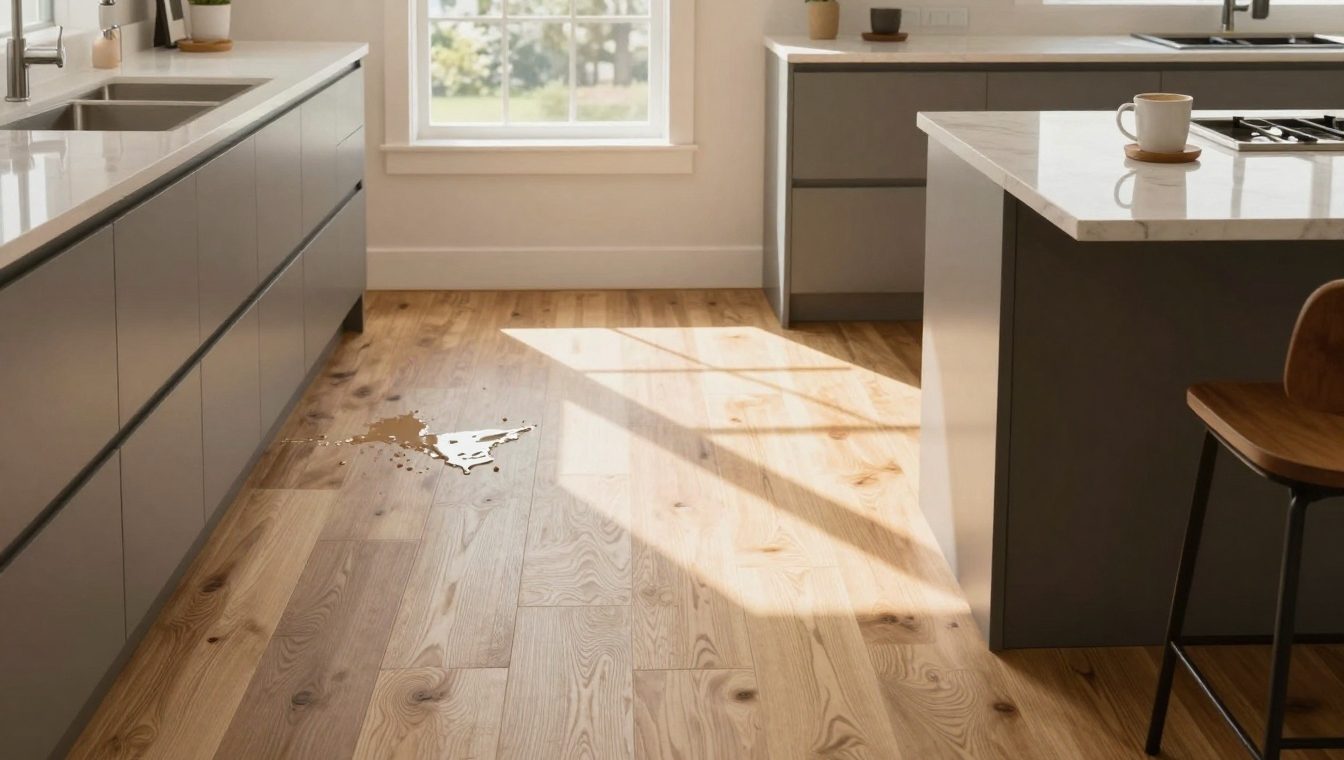
A busy kitchen is where good floors earn their keep. Coffee splashes by the island, melting ice trails from the fridge, a pot boils over, and someone forgets the dish towel by the sink. If we want a warm, natural look, wide plank oak flooring often tops the list. The real question is simple: how does it hold up in Alpharetta kitchens with daily spills?
We install and restore wood floors across Alpharetta and Milton, and we see the same pattern again and again. Oak can perform very well in a kitchen, but only when we match the right plank build, finish, and installation details to a home’s routines.
 Wide plank oak looks calm and uniform, until water sits long enough to find a seam.
Why Alpharetta kitchens are harder on wood than people expect
Daily spills are only half the story. The other half is moisture in the air.
In North Georgia, summer humidity can run high, and indoor humidity swings can be sharp if HVAC cycles vary or doors open often. Wood responds by expanding and shrinking. With wide plank oak flooring (often 5 inches and wider), that movement can show sooner because each board has more width to move.
This does not mean wide plank oak is a bad choice for kitchens. It means we have to treat the kitchen like a “splash zone” and build the floor system for real life, not showroom conditions.
For homeowners comparing wood constructions, our solid wood vs engineered wood flooring guide is a useful starting point.
What happens when oak meets spills (minutes, hours, and weeks)
Oak is a strong species, and its grain structure can tolerate normal household use well. The weak spot is not the oak itself. The weak spot is time.
In the first few minutes, most spills stay on the finish. If we wipe it up quickly, the floor usually has no lasting mark.
After 15 to 60 minutes, water can start to work into micro-scratches in the finish, seams between boards, or around the sink base and dishwasher edge. This is when we can see slight darkening along joints.
After repeated soaking over weeks, the risks increase:
- Staining along board edges or in open grain.
- Cupping (edges lift) if moisture enters from above or below more on one side.
- Crowning (center lifts) in some cases after a cupped floor later dries unevenly.
- Finish failure near sinks, pet bowls, and prep zones, which invites more moisture next time.
Spills do not need to be dramatic. A slow drip line at the dishwasher, or wet shoes drying in the same spot, can do more harm than a one-time splash that gets cleaned fast.
Solid vs engineered wide plank oak for spill-heavy kitchens
When clients tell us their kitchen sees daily water contact, we steer the decision toward stability first, then style. Wide planks amplify seasonal movement, so the core construction matters.
| Option | How it handles Alpharetta kitchens | Spill-related notes |
|---|---|---|
| Solid wide plank oak | Beautiful and traditional, but moves more with humidity swings | Higher risk of cupping if water sits or humidity runs high |
| Engineered wide plank oak | More stable due to layered core | Still needs fast cleanup, but tolerates normal kitchen life better |
| Narrower oak planks (about 3 to 5 inches) | Balanced look with less movement | Often the simplest path to fewer gaps and less cupping |
If you like the wide plank look, engineered wide plank oak is often the safer kitchen pick, especially in homes where cooking is frequent and spills are normal.
Finish choices that decide whether spills become stains
Most homeowners focus on color and plank width. In kitchens, the finish system matters just as much.
Factory-finished vs site-finished
- Factory-finished boards can have strong, consistent topcoats, but seams are still seams. Water can still reach joints if it sits.
- Site-finished floors can be finished wall-to-wall, which helps reduce water entry through seams (the finish bridges small gaps). The quality depends on prep and application.
Water-based vs oil-based polyurethane
- Water-based poly can keep a lighter, cleaner oak tone and dries faster.
- Oil-based poly tends to amber over time and can be very tough.
No finish makes wood “waterproof.” A finish buys us time, and time is what prevents staining.
For broader kitchen guidance from a major hardwood brand, we often point clients to this overview on whether wood flooring is good in kitchens.
The daily-spill routine that protects wide planks
A wide plank kitchen floor does not need babying. It needs consistency.
Wipe fast: A dry towel beats a damp mop when the goal is removing water, not spreading it.
Skip wet mopping: Use a damp, well-wrung microfiber mop. Standing water is the enemy.
Use mats in the right places: One mat by the sink and one by the exterior door can prevent most repeated soak zones. Choose breathable mats and lift them to dry underneath.
Keep indoor humidity in a healthy range: Many wood floor pros target about 35 to 55 percent indoor relative humidity when possible. Stable indoor air reduces seasonal gaps and edge stress at joints.
Catch small leaks early: Dishwasher lines, fridge water supply lines, and sink drain connections cause more long-term damage than most cooking spills.
If you want a real-world view of what homeowners notice over time, this oak kitchen flooring discussion highlights the same themes we see on job sites: wipe fast, control moisture, and protect the sink zone.
When refinishing becomes the smart reset in a kitchen
Even well-maintained kitchens develop wear paths. The area in front of the sink can lose sheen first, and that dulling can let moisture cling longer.
When the floor looks worn but the boards are still sound, sanding and refinishing can restore protection and appearance. As a hardwood floor sanding contractor in alpharetta, we often refinish kitchen floors to remove shallow staining, rebuild the finish layer, and tighten up the “time buffer” that protects against future spills.
You can see examples of refreshed floors in our flooring sample pictures gallery.
Choosing an Alpharetta contractor who plans for spills (not just installs boards)
Wide plank kitchens succeed when the installation plan matches the house. Subfloor prep, moisture checks, acclimation, proper underlayment or vapor control where needed, and correct expansion space all matter.
As a flooring contractor in alpharetta ga, we treat the kitchen as a high-risk moisture zone and plan details accordingly. Many homeowners also ask us to coordinate broader updates, and it helps to work with one team when projects overlap. We regularly serve clients as a local kitchen remodeling contractor in alpharetta, and many first meet us as a bathroom remodeling contractor in alpharetta and Milton while updating tile, showers, and flooring transitions.
If you want to learn more about our full service approach, visit our Alpharetta Floors company overview.
For pricing, we keep it simple. Call us at 470-352-1156 for free estimates. If you show us any existing written quote from another contractor for the same scope and quality, we beat it by 5%.
Conclusion
Daily spills do not automatically rule out wide plank oak flooring in Alpharetta kitchens. The outcome depends on plank construction, finish quality, humidity control, and simple habits like fast wipe-ups. When we plan for moisture and install with care, wide plank oak stays beautiful through real cooking, real kids, and real life. Call 470-352-1156 to schedule a free estimate, and let’s choose a kitchen floor that stays protected long after the first spill.