
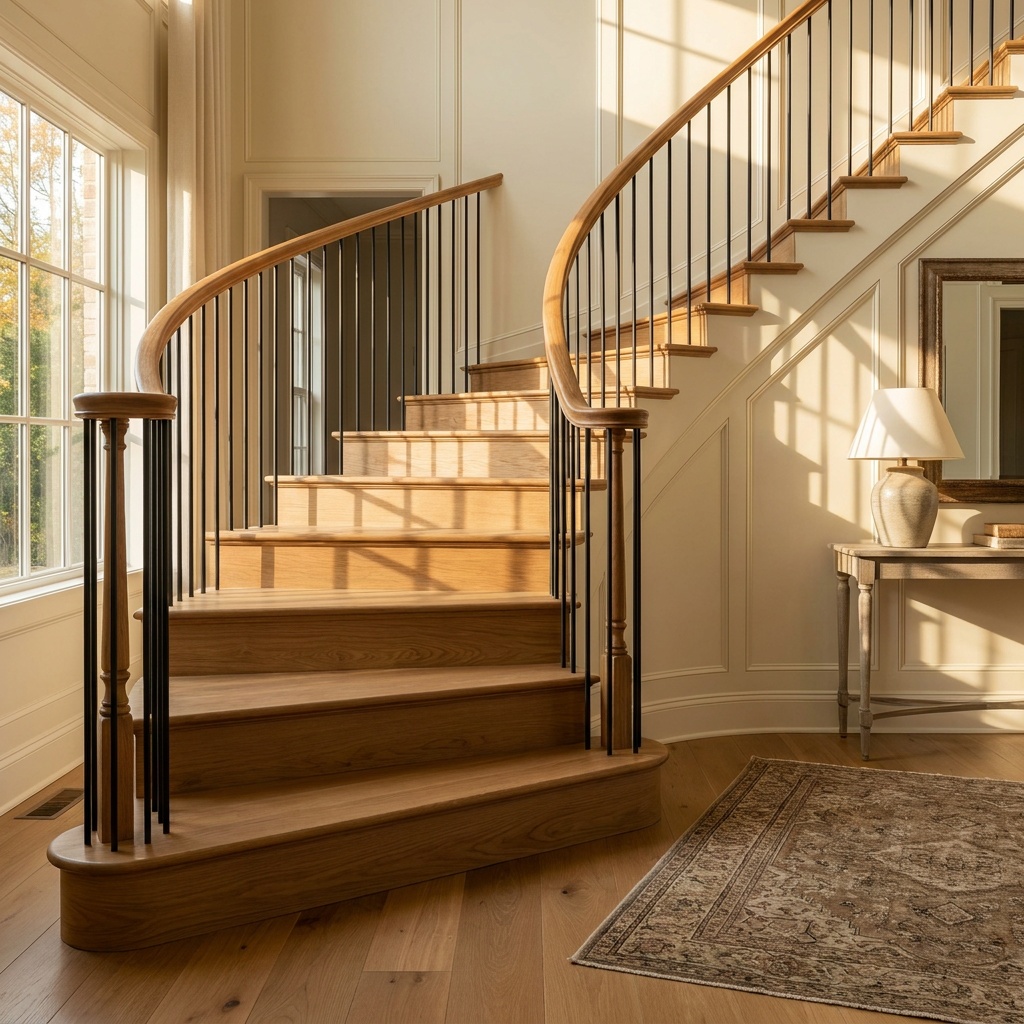
Iron balusters cost more upfront but need almost no upkeep, while wood spindles cost less to install but ask for periodic painting and tightening. Iron gives a staircase a slim, modern, open feel. Wood spindles read as traditional and warm, and they’re easier to match to existing trim. Which one is right for you comes down to style, maintenance tolerance, and how much light you want moving through the stairwell.
The look each one brings to a staircase
Iron balusters are thin. Most run about 1/2 to 5/8 inch in diameter, so a run of them reads as a series of dark lines rather than a wall. That openness lets light from a foyer window carry into a stairwell instead of stopping at the railing. Iron pairs well with hardwood treads, painted risers, and simpler, straighter handrails. It tends to look right in newer builds and in homes that have already moved toward black or bronze hardware in the kitchen and bath.
Wood spindles are thicker, usually 1.25 to 1.75 inches, and often turned with a decorative profile. They read as a solid, traditional element. Painted white, they match classic trim packages common in older Alpharetta and Milton homes. Stained to match the treads, they blend into a warmer, more furniture-like stairway. Wood spindles box in the view a bit more than iron does, which some homeowners actually prefer for a cozier stairwell.
Upkeep — what each one actually needs
Iron does not swell, crack, or shrink with the seasons. It doesn’t respond to humidity. A quick dusting and an occasional touch-up on a scratched spot is about all it asks for. That’s a real advantage in a two-story home where nobody wants to repaint a stair rail every few years.
Wood is a different story. Atlanta homes see indoor humidity swing from roughly 30% in a dry winter to 50% or higher in a humid summer, and wood spindles move with that swing. Over years, joints loosen, paint chips at stress points, and a spindle or two can start to wiggle at the base. Most painted wood balustrades need a repaint or touch-up cycle every 5 to 8 years to stay tight and look fresh. On older homes we work in around Roswell and Duluth, loose or rattly spindles are one of the more common stair complaints we hear — usually fixable, but it’s a maintenance item iron simply doesn’t have.
How each one gets installed
Iron balusters are set after the treads and rail are in place. A baluster shoe screws into the tread, the iron rod seats into a pre-drilled hole in the underside of the handrail, and it’s often locked with epoxy or a set screw. Depending on tread width, a stair typically gets one or two balusters per tread to meet code spacing — the gap between any two balusters has to be small enough that a 4-inch sphere can’t pass through. Because iron doesn’t need painting, the install is largely done once it’s set and tightened.
Wood spindles install differently. They’re usually doweled into a fillet strip at the top and bottom rail, or toe-nailed and filled. That filled nail hole needs sanding before finish goes on. If the spindles are painted, expect two coats of primer and two finish coats, with roughly 24 hours of dry time between coats for a clean result. If they’re stained to match the floor, they need to be color-matched carefully so the stairwell doesn’t look like an afterthought next to a freshly refinished floor.
Either way, stair work is precise, code-driven carpentry. It’s not a weekend swap. If your rail or spindles are original to the house, a full evaluation — treads, risers, rail, and balusters together — is worth doing before committing to one material. That’s the kind of scope our stair remodeling crew walks through during a free consultation.
| Factor | Iron balusters | Wood spindles |
|---|---|---|
| Typical diameter | 1/2 to 5/8 inch | 1.25 to 1.75 inch |
| Visual feel | Slim, open, modern | Solid, traditional, warmer |
| Finish needed | None — factory finish holds | Primer, paint or stain, top coat |
| Response to humidity | None | Expands and contracts with seasonal swings |
| Maintenance cycle | Occasional dusting, rare touch-up | Repaint or tighten every 5-8 years |
| Install method | Shoe-mounted, epoxied or set-screwed into rail | Doweled or toe-nailed between rails |
| Best paired with | Hardwood treads, black or bronze hardware | Painted trim, traditional millwork |
What drives the price
Iron balusters generally cost more per piece than wood spindles, but wood costs more in labor over time because of the finishing steps and future touch-ups. As a rough range, stair remodeling work in this market runs about $100-250 per step, and that figure assumes a ready-to-work stairway with no structural repair, nothing to move out of the way, and standard-grade material. Your actual number depends on step count, baluster spacing, whether the rail is being replaced too, and the finish you choose. A free consultation is the fastest way to get a number that reflects your stairs specifically, not a generic average.
Which one fits your stairs
Start with how you use the space. A stairwell that gets heavy daily traffic and little seasonal attention usually does better with iron — set it and forget it. A traditional home with painted millwork throughout the main level usually looks more coherent with painted wood spindles that match the baseboards and door casings.
Think about light next. If the stairwell sits in a dim hallway, iron’s open sightlines help more than wood’s solid profile. If the stair faces a bright window already, either material works and the choice comes down to style.
Consider what’s happening elsewhere in the house. If you’re refinishing hardwood floors at the same time, it’s worth matching the stair finish to the new floor color rather than choosing balusters in isolation. Our crews handle floor sanding and refinishing and stair work under one contract, which keeps stain colors consistent between the floor and the stair treads instead of guessing at a match later. The same logic applies if new flooring is going in at the same time as the stair update — one flooring installation plan for the whole level avoids mismatched sheen or tone between rooms.
If your household includes young kids who grip the rail hard, wood’s rounder, warmer profile tends to feel friendlier than cold iron in a chilly stairwell in January. If you’re planning to sell in the next few years, slim iron balusters are one of the more recognizable upgrades buyers respond to in listing photos.
With 18+ years doing this kind of work around Alpharetta, Milton, Roswell, Duluth, and Johns Creek, the pattern we see most is simple: homeowners who want low maintenance pick iron, and homeowners chasing a specific traditional style stick with wood and plan for the upkeep. Neither choice is wrong. It’s a matter of which trade-off you’d rather live with.
Frequently asked questions
Can I mix iron balusters with a wood handrail?
Yes, and it’s one of the more common combinations. Iron balusters with a stained wood rail and wood treads is a common look in newer and updated homes, and it keeps warmth at hand height while opening up the view below.
Do wood spindles need to be replaced if they’re loose?
Not always. Loose spindles are often a doweling or fastening issue rather than a sign the wood has failed, and many can be re-glued or re-secured rather than swapped out entirely. A site visit is the only reliable way to tell which repair a given stairway needs.
Which option holds up better with pets and kids?
Iron holds up better against scuffing, scratching, and repeated grabbing since it has no finish to wear through. Wood can handle daily use fine but shows scuffs and paint wear sooner in high-traffic entry stairs.
Should stair balusters match the floor finish or the trim color?
There’s no single right answer, but consistency matters more than the specific choice. Painted spindles usually match trim; stained spindles usually match the floor. Iron sidesteps the question entirely since it doesn’t need to match either.
If you’re weighing iron against wood for a stair update — or want it planned alongside new floors, a kitchen, or a bath — book a free consultation or call 470-352-1156 and we’ll walk the stairs with you and put the options in writing.